SBM-1 – Strategy, business model, and value chain
voestalpine is a global steel and technology group with a unique combination of material and processing expertise. The Group’s organizational structure consists of a holding company and four divisions. With high-quality product and system solutions made from steel and other metallic materials, voestalpine is a leading partner in the automotive, energy, mechanical engineering, consumer goods, and aerospace industries. In addition, voestalpine is the world market leader in rail infrastructure systems, high-quality tool steel, and special sections. voestalpine does not offer products or services that are subject to bans in the respective markets. The Group’s broad customer base contributes to earnings stability in a cyclical market environment overall.
The Steel Division has been setting environmental benchmarks in steel production for years and is developing hydrogen-based future technologies to achieve low-emission steel production. With its high-quality strip steel, the Steel Division is a partner to renowned automotive manufacturers and suppliers around the globe.
The High Performance Metals Division is a global leader in the production and downstream processing of metallic high-performance materials, particularly high-speed steel and other specialty steels, as well as titanium and nickel-based alloys. Customers of these products include, for example, suppliers to the automotive and consumer goods industries, the special machinery sector, as well as the aerospace industry. Following the sale of Buderus Edelstahl in Wetzlar (Germany) in the business year 2024/25, site consolidations outside Austria, capacity adjustments at voestalpine BÖHLER Bleche in Mürzzuschlag (Austria), and the sale of voestalpine BÖHLER Profil, the High Performance Metals Division has largely completed the process of restructuring its portfolio.
The Metal Engineering Division, with its Railway Systems business segment, is a global leader in providing integrated track systems. It provides customized comprehensive solutions for all rail infrastructure segments—from urban and mixed traffic to heavy freight and high-speed networks. Through its Industrial Systems business unit, the division is also the European market leader in high-quality wire and complete welding solutions. As part of the greentec steel program, the Metal Engineering Division is also intensively working on and researching various innovations, climate-friendly technologies, and production processes.
The Metal Forming Division is the center of expertise for highly advanced profile, tube, and precision strip steel products, as well as for ready-to-install system components made from pressed, stamped, and roll-formed parts. These products are used in a wide range of industries.
|
|
2024/25 |
|
2025/26 |
||||
|
|
Total |
|
in % |
|
Total |
|
in % |
|
|
|
|
|
|
|
|
|
European Union (excluding Austria) |
|
8,969.3 |
|
57% |
|
8,784.5 |
|
58% |
Austria |
|
1,083.2 |
|
7% |
|
1,074.4 |
|
7% |
USMCA |
|
2,192.1 |
|
14% |
|
2,078.9 |
|
14% |
Asia |
|
1,430.5 |
|
9% |
|
1,193.5 |
|
8% |
South America |
|
528.0 |
|
3% |
|
447.3 |
|
3% |
Rest of World |
|
1,540.6 |
|
10% |
|
1,484.5 |
|
10% |
Total revenue by region |
|
15,743.7 |
|
100% |
|
15,063.1 |
|
100% |
|
|
|
|
|
|
|
|
|
In millions of euros |
||||||||
|
|
2024/25 |
|
2025/26 |
||||
|
|
Total |
|
in % |
|
Total |
|
in % |
|
|
|
|
|
|
|
|
|
Steel Division |
|
5,799.1 |
|
37% |
|
5,730.6 |
|
38% |
High Performance Metals Division |
|
3,182.2 |
|
20% |
|
2,749.7 |
|
18% |
Metal Engineering Division |
|
4,167.9 |
|
27% |
|
4,054.7 |
|
27% |
Metal Forming Division |
|
3,125.1 |
|
20% |
|
3,030.1 |
|
20% |
Holding & Group Services |
|
1,012.4 |
|
6% |
|
944.2 |
|
6% |
Consolidation |
|
−1,543.0 |
|
−10% |
|
−1,446.2 |
|
−9% |
Total Group |
|
15,743.7 |
|
100% |
|
15,063.1 |
|
100% |
|
|
|
|
|
|
|
|
|
In millions of euros |
||||||||
|
|
2024/25 |
|
2025/26 |
||||
|
|
Total |
|
in % |
|
Total |
|
in % |
|
|
|
|
|
|
|
|
|
Automotive |
|
4,772.2 |
|
30% |
|
4,560.7 |
|
30% |
Energy |
|
2,711.7 |
|
17% |
|
2,413.1 |
|
16% |
Railway systems |
|
2,266.2 |
|
15% |
|
2,211.0 |
|
15% |
Construction |
|
1,503.6 |
|
10% |
|
1,480.9 |
|
10% |
Mechanical engineering |
|
1,280.7 |
|
8% |
|
1,189.5 |
|
8% |
White goods/Consumer goods |
|
651.2 |
|
4% |
|
624.2 |
|
4% |
Aerospace |
|
543.4 |
|
3% |
|
603.3 |
|
4% |
Other |
|
2,014.7 |
|
13% |
|
1,980.4 |
|
13% |
Total revenue by industry |
|
15,743.7 |
|
100% |
|
15,063.1 |
|
100% |
|
|
|
|
|
|
|
|
|
In millions of euros |
||||||||
voestalpine comprises about 500 Group companies and sites in over 50 countries on five continents. As of the reporting date (March 31, 2026), the voestalpine Group had a global workforce of 48,010 employees (2024/25: 49,298) (including apprentices). 50.1% (2024/25: 49.3%) of the employees are based in Austria, while 49.9% (2024/25: 50.7%) work at sites outside Austria.
In each case as of the March 31 reporting date |
|
2024/25 |
|
2025/26 |
||||
|
|
Total |
|
in % |
|
Total |
|
in % |
|
|
|
|
|
|
|
|
|
European Union (excluding Austria) |
|
13,732 |
|
29% |
|
13,211 |
|
28% |
Austria |
|
24,323 |
|
49% |
|
24,039 |
|
50% |
USMCA |
|
3,388 |
|
7% |
|
3,220 |
|
7% |
Asia |
|
3,190 |
|
6% |
|
3,121 |
|
6% |
South America |
|
2,694 |
|
5% |
|
2,530 |
|
5% |
Rest of World |
|
1,971 |
|
4% |
|
1,889 |
|
4% |
Total employees |
|
49,298 |
|
100% |
|
48,010 |
|
100% |
The Group Strategy 2030+ sets the course for voestalpine for the years ahead and is our answer to the challenges and opportunities arising from a dynamic, constantly changing environment. The fundamental core objectives of our strategy are sustainable, value-enhancing growth in the attractive fields of the further processing of steel and metallic materials as well as long-term sustainability and the Group’s resilience.
According to the guiding principle, “We are shaping a better, safer and more sustainable future,” as a steel and technology Group, we have set ourselves the objective of being an economic leader, with sustainable, innovative product and system solutions made of high-quality steel and high-performance materials. We use our unique blend of materials and processing expertise to create innovative solutions that give our customers a real competitive advantage. The decentralized, divisional organizational structure of voestalpine increases the customer proximity, speed, flexibility, and adaptability of our specialized business segments, while the broad diversification across segments, regions, and products ensures additional stability. Networking and leveraging synergies between the business segments create added value in the Group. In addition, our stable ownership structure leads to strategic independence in the interest of all stakeholders. In line with our overarching strategic objective of adding value and thus increasing the value of the Group, focused growth in attractive, high-yield sectors such as rail infrastructure, aerospace, special profiles, and warehouse technology is an essential strategic pillar. We are further developing our product portfolio with innovative solutions, strengthening the factors that set us apart in our core markets and focusing on further targeted internationalization in growth markets and regions.
Active and consistent management of our portfolio, focusing on efficiency in all areas and strengthening the competitiveness of our (production) sites as well as the reorganization of low-return business units, also ensures the sustainability and resilience of the Group and thus constitutes the second essential pillar of our strategy. The economically successful decarbonization of blast furnace-based steel production with the clear target of achieving net-zero emissions by 2050 and the further development and expansion of the circular economy is the third essential pillar of our strategy. As an international Group, voestalpine is committed to the global climate targets and is working intensively on technologies to reduce GHG emissions as well as on long-term decarbonization.
Sustainability strategy and targets
The sustainability strategy of voestalpine forms an integral part of the Group’s corporate strategy and is operationalized within the individual divisional, business unit, and functional strategies. With its comprehensive sustainability strategy, voestalpine pursues an integrated approach and has formulated strategic principles and targets for each sphere of action. The sustainability strategy is based on the three pillars of the business & ethical corporate governance, a commitment to climate action & environmental protection, and employees & society.
As part of stakeholder management, voestalpine communicates its policy and related progress both internally and externally. For this purpose, voestalpine maintains contact with all relevant stakeholders by engaging in a responsible, solution-oriented, and transparent dialogue with them. This is facilitated through numerous platforms such as professional discussions, roundtables, conferences, and trade shows, as well as analyst and investor meetings. In line with its Code of Conduct, voestalpine actively participates in a wide variety of bodies serving advocacy groups, trade associations, and lobbying campaigns. For more information on stakeholder management, please refer to SBM‑2. More information on stakeholder management is provided in section SBM‑2. The Group Sustainability department, which was newly created in 2023, acts as the central coordination point for the implementation and further development of the sustainability strategy.
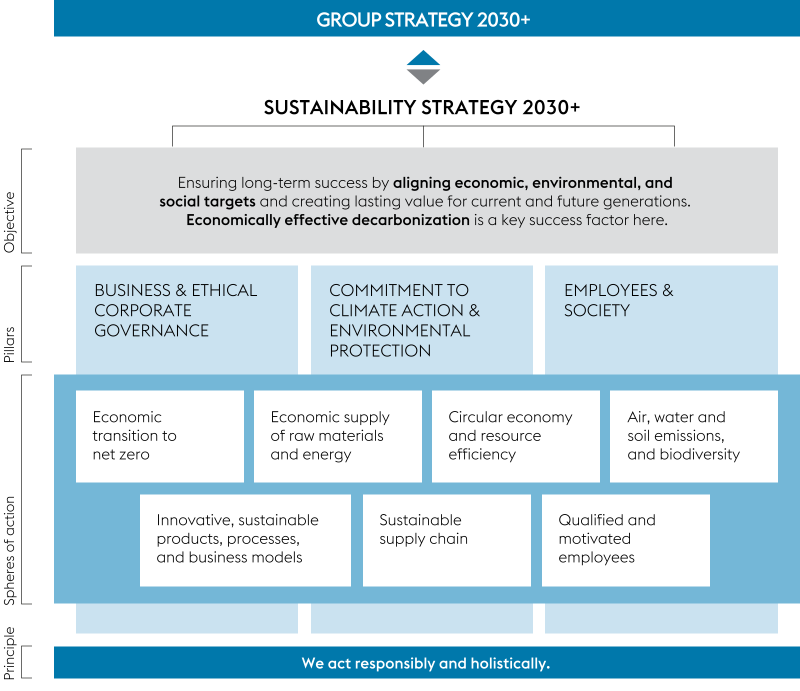
Faced with increasing pressure to reduce GHG emissions and the need to curb climate change, steel producers must find alternative methods to achieve more environmentally friendly production. voestalpine is investing in hydrogen-based and pioneering technologies to enable low-emission production.
voestalpine is committed to clear sustainability goals and has net-zero emissions by 2050. Within the scope of the Science Based Targets initiative (SBTi), the voestalpine Group is committed to reducing total Scope 1 and Scope 2 emissions by 30% and Scope 3 emissions by 25% by 2029 compared to the reference year 2019. This planned reduction corresponds to a “well below 2 °C” scenario. This target was set at the Group level and relates to the gradual decarbonization of the production sites. The target has not been rolled out for customer groups, specific products or regions. Achievement of the target is also subject to external factors and influencing variables, such as the availability of raw materials and renewable energy as well as the economic situation. For more information, see chapter E1.
In order to meet the challenge of decarbonizing steel production while maintaining cost-effectiveness and competitiveness, and achieve the net-zero target by 2050, voestalpine has developed the ambitious greentec steel climate protection program as a core element of the Group and sustainability strategy. Blast furnace-based steel production in the Steel Division and the Metal Engineering Division will be gradually decarbonized by 2050.
In the first phase, EUR 1.5 billion is already being invested in one green-powered electric arc furnace in Linz and one green-powered electric arc furnace system in Donawitz to replace one blast furnace at each location. The materials used involve a mix of scrap, liquid pig iron, and hot briquetted iron (HBI), with the mix adjusted according to the specific quality requirements. These electric arc furnaces, which are already under construction, will go into operation in 2027 and significantly reduce Scope 1 and Scope 2 CO2 emissions by a total of 30% by 2029 by increasing the use of electricity instead of coal and coke. This represents almost 5% of Austria’s entire annual CO2 emissions, making greentec steel the country’s largest climate protection program.
Further information about the greentec steel climate protection program is provided in chapter E1 and I, R&D.
Other challenges for voestalpine in the context of climate change lie in securing the necessary raw materials and energy sources, demand for which will change as steel production is transformed. In order to address these challenges, voestalpine has set itself the strategic objectives of economically securing the supply of the production sites with the required raw materials and energy in the long term, as well as further expanding the circular economy and increasing the use of scrap as a secondary raw material in steel production by 50% by 2030. These packages of actions are already being implemented and will continue to be developed. For more information, see chapters E1 and E5.
Another strategic challenge for voestalpine in the context of sustainability is to continue to attract and retain qualified and motivated employees in line with its requirements as the basis for economic success. To this end, voestalpine relies on various policies and actions—based on its already high level of commitment and above-average employee retention. For more information, see chapter S1.
In addition, the health of employees and the ongoing assurance and enhancement of occupational safety are core values at voestalpine and are given top priority. Continuous efforts are therefore being made to further reduce the frequency of accidents and increase the health index in order to move closer to the vision of “zero accidents.” Strategically, the accident frequency rate is to be reduced by 5.5% by 2030. Group-wide safety standards form the basis of a successful corporate culture rooted in health and safety. For more information, see chapter S1.
Moreover, voestalpine addresses sustainability in its supply chain and works to counter the material negative impacts identified. For more information, see below and chapter S2.
Value chain and business model
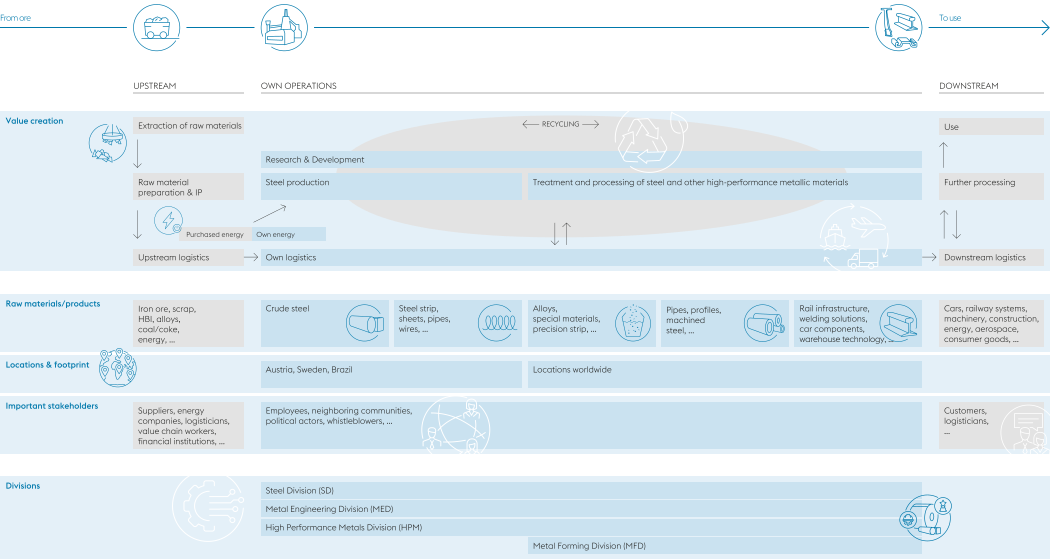
At the heart of voestalpine’s business model is the efficient production and processing of high-quality steel products and other high-performance metallic materials for applications subject to high quality and technology requirements, while adhering to stringent sustainability standards throughout the entire value chain. This covers the mining of raw materials, production, use, and recycling of products. The following figure illustrates voestalpine’s comprehensive value chain in consideration of upstream value added, in-house activities, and downstream value added.
In the upstream value chain, voestalpine relies on essential raw materials such as iron ore, various alloys, steel scrap, coal, and coke, which are sourced from North America, South America, Europe, Africa, Australia, and parts of Asia. In the course of the transition to low-emission production, demand for raw materials is changing in response to technological transformation. For example, in addition to the gradual reduction in the use of coal and coke, the strategic increase in the use of recycled steel scrap reduces the need for iron ore. This recycled scrap comes from both industrial and post-consumer sources.
In addition to the raw materials, the supply of energy, which is provided by regional and international energy suppliers, is crucial. This also applies to the necessary supply of water. Other materials, machinery, and equipment procured by global suppliers are also essential. Global logistics service providers as well as some of the company’s own logistics manage the transport of raw materials and other goods to the production sites.
The combination of material and processing expertise as a key factor in voestalpine’s success is reflected in the broad value chain in the Group’s own business activities. This ranges from the steel production and the further processing and refinement of the products to the production of ready-to-install components, system solutions, and services. Steel production takes place at sites in Austria, Sweden, and Brazil, while further production steps are distributed globally. The specific activities and final products of the divisions vary depending on the business unit. The undertaking’s own logistics ensures the transport of materials and semi-finished products to and between the undertaking’s sites. At its large production sites, voestalpine generates electricity from process gases and uses it to power both the production process and the downstream processing steps. This enables the Group to cover a large part of its electricity requirements from its own generation.
voestalpine manufactures various flat and long products, but also further-processed products and ready-to-install components, e.g., for tool making, the automotive and energy industry, aerospace, construction and mechanical engineering, the consumer goods and food industry, as well as system solutions, for example for railway infrastructure or storage technology.
Research and development is pursued along all production activities of voestalpine, especially with regard to decarbonizing steel production. The increased expansion of the circular economy, in particular with the use of recycled materials such as steel scrap, or the reprocessing of by-products, will make production more sustainable. At the same time, state-of-the-art technologies and optimized processes make it possible to increase efficiency along the entire production chain and significantly improve the Group’s environmental footprint.
In its own operations, voestalpine attaches great importance to the safety and well-being of its employees in order to ensure sustainable and responsible production. Employees can express their interests to the company in various ways and trust that their needs will be taken into account in decision-making processes.
The downstream value chain includes the worldwide transportation of voestalpine products to business customers, their industrial processing, and final use by end customers. At the end of their useful life, a proportion of the products are recycled. This promotes a circular economy and contributes to the company’s sustainability goals. In the event of planned operational changes at the sites, the neighboring communities, political actors, and other stakeholders are involved in order to take local requirements into account and promote social acceptance.
The customers of voestalpine are made up of business customers from various industries and geographical markets, in particular from the automotive, energy, and aerospace industries, rail infrastructure, mechanical engineering, and the construction and consumer goods industry. The main geographical markets are located in Europe, North and South America, Asia and, depending on the business unit, in additional complementary markets.
A close dialogue is maintained between voestalpine and its customers, who are placing increasingly high demands on reducing the carbon footprint in their supply chains. This demand for “green steel” has led to an uptick in the development of solutions produced in collaboration with customers to increase efficiency and reduce emissions throughout the product lifecycle. These include innovative recycling processes and energy-efficient production technologies.
Additionally, voestalpine attaches great importance to transparency in the value chain. Environmental impacts and adverse social impacts, such as labor and human rights violations, need to be minimized to the greatest possible extent. In cooperation with suppliers, attention is paid to compliance with environmental and social standards.