Disclosures required by the EU-Taxonomy Regulation
General information on the taxonomy
Since January 1, 2022, public-interest entities in the EU with more than 500 employees must classify their economic activities in accordance with the EU Taxonomy Regulation and publish the results in their consolidated sustainability reporting (pursuant to the requirements of Section 267a and Section 243b Austrian Commercial Code (UGB)). All economic activities are to be classified as to their environmental sustainability.
When classifying its economic activities, voestalpine at times refers to the FAQs on the application of the EU taxonomy published in the EU Official Journal on October 20, 2023, and to the FAQs from March 5, 2025.
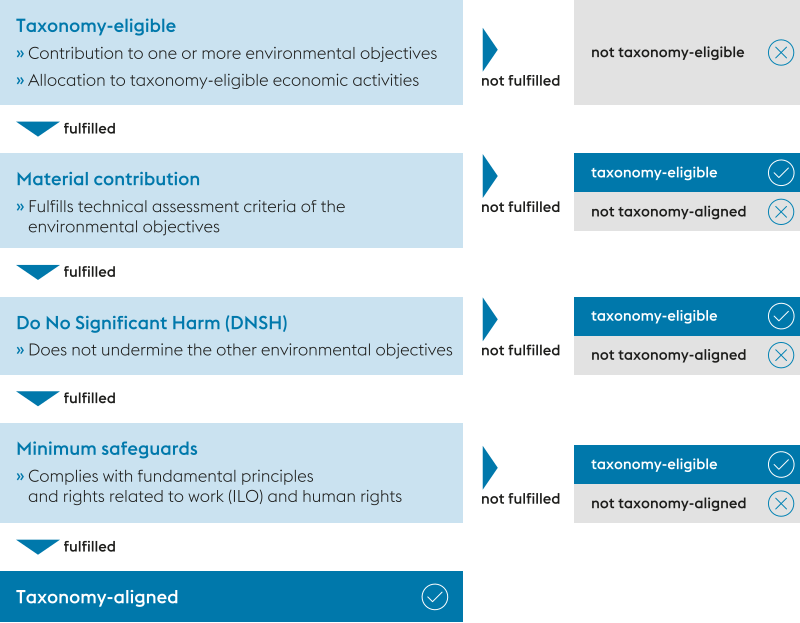
Assessment of alignment with the taxonomy regulations is carried out in a multi-stage process in which it is first determined whether an economic activity is taxonomy-eligible (i.e., in principle covered by the Taxonomy Regulation), and subsequently whether it is also taxonomy-aligned. Economic activities of a company that are not covered by the Taxonomy Regulation are not taxonomy-eligible.
The taxonomy-eligible economic activities must make a significant contribution to at least one of the environmental objectives listed below in order for them to be classified as taxonomy-aligned. In addition, they must not significantly impair the achievement of other environmental goals (Do No Significant Harm; DNSH) and must meet minimum social protection criteria (minimum safeguards), e.g., with respect to occupational safety and human rights.
The EU Regulation identifies six environmental objectives:
Climate change mitigation
Climate change adaptation
Sustainable use and protection of water and marine resources
Transition to a circular economy
Pollution prevention and control
Protection and restoration of biodiversity and ecosystems
In implementing the EU Taxonomy Regulation, voestalpine classified all of its economic activities as related to the “climate change mitigation” objective. This also prevents activities from being counted twice.
Implementation of taxonomy eligibility in the voestalpine
The assessment of voestalpine’s economic activities with regard to their taxonomy eligibility was carried out for the first time in the business year 2021/22. Environmental goals 3 to 6 were also analyzed and evaluated with regard to their taxonomy eligibility as part of the business year 2023/24 reporting.
A project team comprising personnel from the Group’s Finance, Investor Relations, Environment, and Group Sustainability departments along with experts from each division was set up to this end. External experts were also consulted, including technical experts and scientific experts. In addition, clarifying interpretations and statements from European industry associations, such as the rail industry association UNIFE, were taken into account in the assessment.
The implementation process included reviewing the taxonomy eligibility of all Group entities. In addition, ongoing evaluation is carried out with regard to the applicability of the business activities to all environmental objectives.
This analysis identified economic activities of the voestalpine Group as taxonomy-eligible and allocated them to the following categories under the climate change mitigation objective:
3.9 Manufacture of iron and steel
The voestalpine Group engages in steel production based on the blast furnace route in Linz, Austria (Steel Division), and in Donawitz, Austria (Metal Engineering Division). The High Performance Metals Division engages in steel production based on electric arc furnace technology at two plants in Europe (Kapfenberg, Austria; and Hagfors, Sweden) and one in South America (Sumaré, Brazil).
6.14 Infrastructure for rail transport
Worldwide, the voestalpine Group produces material components for railway infrastructure (Metal Engineering Division). These components include rails, turnout systems (from components to pre-assembled complete systems including drives, locking systems, and monitoring equipment), diagnostic and monitoring systems, as well as railway infrastructure services (logistics, rail treatments, rail welding, rail grinding, recycling, etc.).
Determination of taxonomy alignment
The underlying technical assessment criteria must be fulfilled in order for an economic activity to be classified as “environmentally sustainable” under the taxonomy regulations. These are quantifiable guidelines (environmental targets) on how an activity should be assessed in terms of its contribution to the respective environmental target. The Taxonomy Regulation specifies this significant contribution to the respective environmental target and also defines whether these economic activities cause significant harm to any of the relevant environmental targets. The DNSH criteria (Do No Significant Harm) must therefore also be observed in addition to the significant contribution criterion. This review must provide evidence that a given economic activity does not undermine the other environmental objectives.
voestalpine makes comprehensive contributions to climate change mitigation. As far as the business activities related to the production and downstream processing of steel are concerned, they are generally deemed to contribute substantially to climate change mitigation as long as they fulfill the significant contribution to the environmental goal of climate change mitigation pursuant to Category 3.9 or are lower than the predefined limits on CO2 emissions. As far as the business activities of voestalpine Railway Systems 6.14 are concerned, they are generally deemed to make a substantial contribution to climate change mitigation as long as they fulfill the technical assessment criteria set forth in that category. The services of voestalpine Railway Systems fulfill the requirement that they are suitable for the use of trains with no direct CO2 exhaust emissions. Services for rail tracks that are only intended for the transportation of fossil fuels are not included.
A comprehensive DNSH conformity assessment was carried out for the relevant economic activities (3.9, 6.14).
The review of the DNSH criterion regarding the environmental objective “climate change adaptation” was conducted using a simulation-based software tool for identifying, quantifying, and disclosing physical climate risks to the relevant operating sites. A detailed climate risk and vulnerability analysis was performed for all relevant sites based upon this review. The representative concentration pathways RCP 2.6, RCP 4.5, RCP 6.0, and RCP 8.5 of the future scenarios used by the Intergovernmental Panel on Climate Change (IPCC), the assessment reports on climate change by the IPCC, and central Copernicus services of the European Commission are used as the methodological basis. Adaptation solutions were determined as necessary and implemented based on the findings of this climate risk and vulnerability assessment.
In addition, the voestalpine Group also uses its management systems, such as the environmental management systems certified according to ISO 14001 or EMAS, which are widely implemented in the companies worldwide, to fulfill the DNSH criteria. These systems ensure that environmental impacts are identified and reviewed as to their relevance to a given operating site’s local environment and that any adaptation solutions aimed at impact mitigation are developed as necessary.
In particular, these analyses comprise and/or take into account environmental matters such as water (sustainable use and protection of water and marine resources) and biodiversity (protection and restoration of biodiversity and ecosystems).
In order to prevent and reduce environmental pollution, the voestalpine Group has created processes in its companies that ensure the production, use, and marketing of substances in accordance with the national laws on chemicals.
In accordance with the DNSH requirements, certain bans and restrictions on substances based on European specifications must be observed, and substances with properties of very high concern may only be used if no other technically and economically suitable alternative substances or technologies are available on the market. If such a replacement is not yet possible, these substances must be used under controlled conditions. The Group-wide review of the DNSH compliance criteria came to the conclusion that these are already met to a very high degree at the sites carrying out the relevant economic activities. Non-compliant sub-areas were excluded from the calculation of the relevant key figures. Appropriate measures have been introduced to increase the degree of fulfillment on a continuous basis.
The dynamic development of EU Taxonomy Regulations may lead to adjustments to economic activities and adaptations to the assessment criteria in the future.
Minimum safeguards
All economic activities that contribute substantially to at least one of the six environmental objectives, do not adversely affect another objective, and fulfill the (social) minimum safeguard requirement are recognized as being environmentally sustainable. In accordance with Article 18 of the EU Taxonomy Regulation, the review of the minimum social protection of workers and compliance with human rights is also the final stage of taxonomy alignment. This serves to ensure that a given economic activity is undertaken in compliance with international human rights standards as well as rules and regulations regarding issues such as bribery, corruption, taxation, and fair competition. The standards specified in Article 18 identify four core topics in regards to which alignment with minimum safeguards is defined.
The following guidelines and standards must be complied with:
- OECD Guidelines for Multinational Enterprises
- UN Guiding Principles (UNGPs) on Business and Human Rights
- ILO Declaration on Fundamental Principles and Rights at Work (“ILO Core Conventions on Labor”)
- International Bill of Human Rights
The Platform on Sustainable Finance (PSF) takes up the following central issues as they apply to social minimum safeguards:
- Human rights (incl. rights of workers)
- Avoidance of bribery and corruption
- Taxation
- Fair competition
voestalpine has already surveyed the aforementioned topics of the Platform on Sustainable Finance on a Group-wide basis in the past. This is also covered comprehensively in this sustainability statement (see, for example, sections S1, S2 on human rights, and G1 on the topic of anti-corruption).
Significant changes from the previous year
Initial application of the Omnibus Directive
In the current reporting year, voestalpine has made use of the option of early application of the Omnibus Directive in the context of EU taxonomy reporting (Delegated Regulation 2026/73). The initial application of the Omnibus Directive did not result in any material impacts to the underlying structure of the EU taxonomy indicators; but a materiality threshold of 5% was introduced in relation to the corresponding aggregate indicators for each economic activity. If the analysis of economic activities for revenue, CapEx, and OpEx produced values below 5%, the economic activity in question was classified as an unassessed/immaterial economic activity and therefore not separately reported. According to the Omnibus Directive, the cumulative unassessed/immaterial economic activities may not exceed 10% of the total reported for each KPI (revenue, CapEx, OpEx). In the current business year, CapEx accounts for the highest unassessed/immaterial activities of 4.8%. In addition, the new reporting forms according to the Omnibus Directive were applied for the first time in the reporting year. The change concerns in particular the structured presentation of the revenue, CapEx, and OpEx indicators and aims to simplify and improve the comparability of disclosures.
In addition, cross-cutting activities had no material impact on business activity or the taxonomy KPIs in prior reporting periods and were therefore subject to simplified reporting as taxonomy-non-eligible. However, the new taxonomy templates also require companies to report the percentage shares of the respective KPIs that are classified as immaterial and unassessed. The Omnibus Directive requires immaterial activities to be quantified starting from the current reporting period in order to ensure compliance with the threshold. The voestalpine Group has defined the following as unassessed/immaterial activities: economic activity 3.21 “Manufacturing of aircraft,” economic activity 6.2 “Freight rail transport,” and activities in class 7 “Construction and real estate.” These are not reported separately; they are recorded in the template as immaterial activities. Reporting is thus carried out in accordance with the updated regulatory requirements. voestalpine will continue to monitor developments in regulatory requirements related to the EU Taxonomy Regulation and Omnibus Directive and will adapt its reporting accordingly if necessary.
Economic activity 6.2. Freight rail transport
The scope of the reported taxonomy-eligible economic activities was reviewed as part of the materiality assessment following the initial application of the Omnibus Directive. It was decided that economic activity 6.2 “Freight rail transport” would no longer be recorded as material in the year under review. This decision is based on the quantitative assessment of the associated performance indicators. The proportions of revenue, CapEx, and OpEx attributable to economic activity 6.2 are each below the materiality threshold of 5% in relation to the Group’s corresponding figures. Against this backdrop, this economic activity is not considered to be material for voestalpine’s EU Taxonomy reporting.
Results of the KPIs
The following summarizes the performance indicators of revenue, CapEx, and OpEx from taxonomy-eligible and taxonomy-aligned economic activities of voestalpine for each environmental target for the business year 2025/26.
2025/26 |
|
|
|
|
|
|
|
|
|
Breakdown of taxonomy-aligned activities by environmental objective |
|
|
|
|
|
|
|
|
|
|
|||||||||||||
|---|---|---|---|---|---|---|---|---|---|---|---|---|---|---|---|---|---|---|---|---|---|---|---|---|---|---|---|---|---|---|---|---|---|
KPI |
|
Total |
|
Proportion of taxonomy-eligible activities |
|
Taxonomy-aligned activities |
|
Proportion of taxonomy-aligned activities |
|
Climate change mitigation |
|
Climate change adaptation |
|
Water |
|
Circular economy |
|
Pollution |
|
Biodiversity |
|
Proportion of enabling activities |
|
Proportion of transition activities |
|
Immaterial, unassessed activities1 |
|
Taxonomy-aligned activities in the previous business year 2024/25 |
|
Proportion of taxonomy-aligned activities in the previous business year 2024/25 |
|||
|
|
|
|
|
|
|
|
|
|
|
|
|
|
|
|
|
|
|
|
|
|
|
|
|
|
|
|
|
|
|
|||
Revenue |
|
15,063.1 |
|
14.8% |
|
2,023.4 |
|
13.4% |
|
13.4% |
|
0.0% |
|
0.0% |
|
0.0% |
|
0.0% |
|
0.0% |
|
13.4% |
|
0.0% |
|
2.4% |
|
1,911.2 |
|
12.2% |
|||
CapEx |
|
949.7 |
|
49.9% |
|
381.8 |
|
40.2% |
|
40.2% |
|
0.0% |
|
0.0% |
|
0.0% |
|
0.0% |
|
0.0% |
|
8.3% |
|
31.9% |
|
4.8% |
|
237.4 |
|
20.4% |
|||
OpEx |
|
993.0 |
|
33.8% |
|
102.1 |
|
10.3% |
|
10.3% |
|
0.0% |
|
0.0% |
|
0.0% |
|
0.0% |
|
0.0% |
|
8.1% |
|
2.2% |
|
2.9% |
|
114.2 |
|
10.9% |
|||
|
|
|
|
|
|
|
|
|
|
|
|
|
|
|
|
|
|
|
|
|
|
|
|
|
|
|
|
|
|
|
|||
|
|||||||||||||||||||||||||||||||||
Taxonomy-eligible/aligned revenue
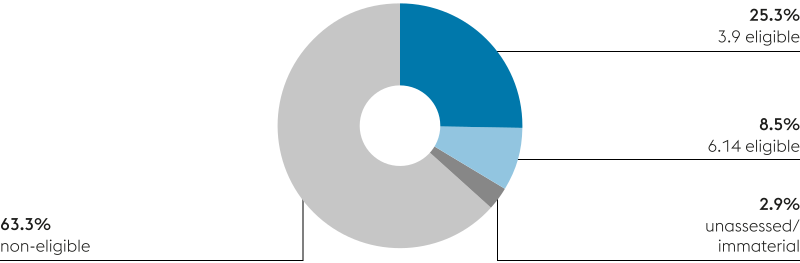
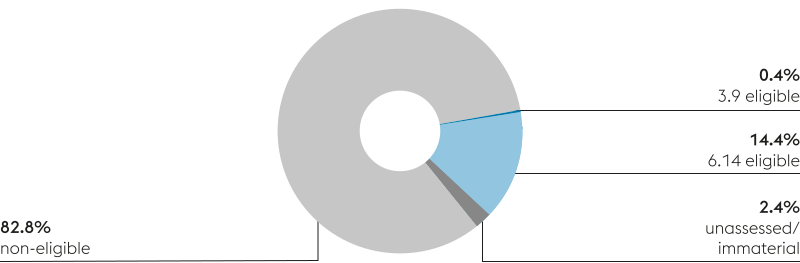
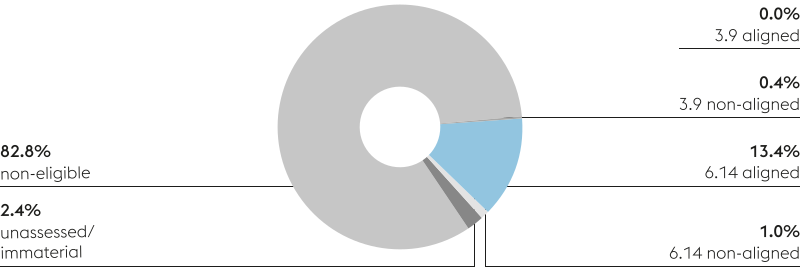
Pursuant to the EU Taxonomy Regulation, revenue as per IAS 1.82(a) must be used to determine the taxonomy-eligible revenue. The revenue figures equate to the revenue shown in the Consolidated Income Statement of this Annual Report and thus are used as the denominator for the calculation in the following table. The numerator includes OpEx generated by economic activities covered by the EU Taxonomy Regulation. The current review for compliance in the 2025/26 business year resulted in 13.4% taxonomy-aligned revenue, all of which is attributable to revenue from the railway infrastructure segment.
This leads to the following classification for the voestalpine Group:
2025/26 |
|
|
|
|
|
|
|
|
|
Taxonomy-aligned activities by environmental objective |
|
|
|
|
|
|
||||||||||
|---|---|---|---|---|---|---|---|---|---|---|---|---|---|---|---|---|---|---|---|---|---|---|---|---|---|---|
Economic activities |
|
Code |
|
Taxonomy-eligible revenue |
|
Taxonomy-aligned revenue |
|
Taxonomy-aligned revenue |
|
Climate change mitigation |
|
Climate change adaptation |
|
Water |
|
Circular economy |
|
Pollution |
|
Biodiversity |
|
Enabling activity |
|
Transition |
|
Taxonomy-aligned share of taxonomy-eligible activities |
|
|
|
|
|
|
|
|
|
|
|
|
|
|
|
|
|
|
|
|
|
|
|
|
|
|
|
Manufacture of iron and steel |
|
CCM 3.9/CCA 3.9 |
|
0.4% |
|
– |
|
0.0% |
|
0.0% |
|
0.0% |
|
0.0% |
|
0.0% |
|
0.0% |
|
0.0% |
|
|
|
T |
|
0.0% |
Infrastructure for rail transport |
|
CCM 6.14/CCA 6.14 |
|
14.4% |
|
2,023.4 |
|
13.4% |
|
13.4% |
|
0.0% |
|
0.0% |
|
0.0% |
|
0.0% |
|
0.0% |
|
E |
|
|
|
93.1% |
Total alignment by objective |
|
|
|
|
|
|
|
|
|
13.4% |
|
0.0% |
|
0.0% |
|
0.0% |
|
0.0% |
|
0.0% |
|
|
|
|
|
|
Total revenue |
|
|
|
14.8% |
|
2,023.4 |
|
13.4% |
|
13.4% |
|
0.0% |
|
0.0% |
|
0.0% |
|
0.0% |
|
0.0% |
|
13.4% |
|
0.0% |
|
90.7% |
Taxonomy-eligible/aligned capital expenditure (CapEx)
Additions to assets—including additions from business combinations to property, plant and equipment; intangible assets; and right-of-use assets under leases—were utilized as the basis for determining the taxonomy-eligible CapEx. Investments via joint ventures, investments in financial instruments as well as additions to goodwill were not considered. Due to the clarification of FAQ 2023/305 item 31, which stipulates that capital expenditure should only be recognized when it is recognized in accordance with the relevant invoicing standards, the additions to advance payments made were excluded from the additions to the CapEx KPI. When the underlying property, plant and equipment/intangible assets are capitalized, the advance payments made on the respective asset are reclassified and also allocated to the additions to the CapEx KPI. This approach may result in a shift between the business years. The difference between the capital expenditure used here in the denominator and the data published in Note D.2. Operating segments in the notes to the Consolidated Financial Statements relates to goodwill additions and the above-mentioned change in advance payments made. The numerator includes CapEx that relates to assets or processes that are associated with taxonomy-eligible or taxonomy-aligned economic activities and are part of the CapEx plan.
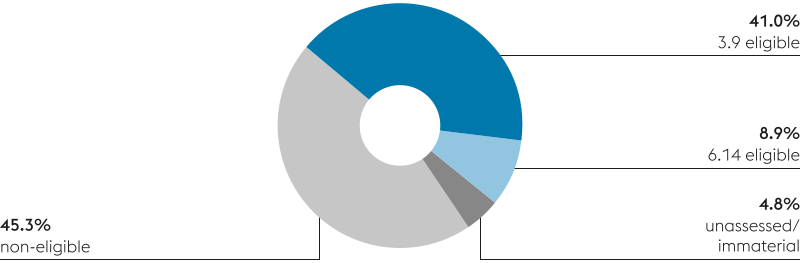
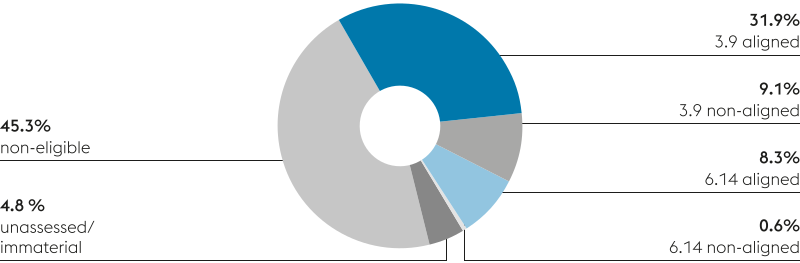
In terms of CapEx, the taxonomy-aligned share is 40.2% (EUR 381.8 million). With greentec steel, voestalpine has developed an ambitious phased plan for low-carbon steel production. As part of the first stage of the phased plan, one green electricity-powered electric arc furnace (EAF) will be built in Linz and one green electricity-powered electric arc furnace system in Donawitz. This will make it possible to produce around 2.5 million tons of CO2-reduced steel each year from 2027 following the ramp-up. This first phase of the greentec steel flagship project is also included in the CapEx plan. The individual processes within the scope of future EAF production are to be regarded as independent production units, which will be integrated into the existing plant configurations at the Linz and Donawitz sites. Taxonomy alignment within the context of economic activity 3.9 Manufacture of iron and steel can be determined for electric arc furnaces as an independent production unit with the corresponding technical screening criteria under the environmental objective of climate change mitigation. The CapEx plan has a total volume of EUR 1.5 billion and is expected to be completed in the 2027/28 business year. In the past business year, EUR 292.7 million (2024/25: EUR 134.4 million) was classified as taxonomy-aligned under economic activity 3.9 Manufacture of iron and steel.
The taxonomy-aligned CapEx of EUR 381.8 million is made up of additions to property, plant and equipment and intangible assets of EUR 371.1 million; additions to property, plant and equipment and intangible assets from business combinations of EUR 2.0 million; and the change in advance payments of EUR 8.7 million. The total CapEx of EUR 949.7 million is made up of additions to property, plant and equipment and intangible assets of EUR 1,066.1 million; additions to property, plant and equipment and intangible assets from business combinations of EUR 2.2 million; and the change in advance payments of EUR −118.6 million.
This leads to the following classification for the voestalpine Group:
2025/26 |
|
|
|
|
|
|
|
|
|
Taxonomy-aligned activities by environmental objective |
|
|
|
|
|
|
||||||||||
|---|---|---|---|---|---|---|---|---|---|---|---|---|---|---|---|---|---|---|---|---|---|---|---|---|---|---|
Economic activities |
|
Code |
|
Taxonomy-eligible CapEx |
|
Taxonomy-aligned CapEx |
|
Taxonomy-aligned CapEx |
|
Climate change mitigation |
|
Climate change adaptation |
|
Water |
|
Circular economy |
|
Pollution |
|
Biodiversity |
|
Enabling activity |
|
Transition activity |
|
Taxonomy-aligned share of taxonomy-eligible activities |
|
|
|
|
|
|
|
|
|
|
|
|
|
|
|
|
|
|
|
|
|
|
|
|
|
|
|
Manufacture of iron and steel |
|
CCM 3.9/CCA 3.9 |
|
41.0% |
|
303.3 |
|
31.9% |
|
31.9% |
|
0.0% |
|
0.0% |
|
0.0% |
|
0.0% |
|
0.0% |
|
|
|
T |
|
77.8% |
Infrastructure for rail transport |
|
CCM 6.14/CCA 6.14 |
|
8.9% |
|
78.5 |
|
8.3% |
|
8.3% |
|
0.0% |
|
0.0% |
|
0.0% |
|
0.0% |
|
0.0% |
|
E |
|
|
|
92.8% |
Total alignment by objective |
|
|
|
|
|
|
|
|
|
40.2% |
|
0.0% |
|
0.0% |
|
0.0% |
|
0.0% |
|
0.0% |
|
|
|
|
|
|
Total CapEx |
|
|
|
49.9% |
|
381.8 |
|
40.2% |
|
40.2% |
|
0.0% |
|
0.0% |
|
0.0% |
|
0.0% |
|
0.0% |
|
8.3% |
|
31.9% |
|
80.6% |
Taxonomy-eligible/aligned operating expenditures (OpEx)
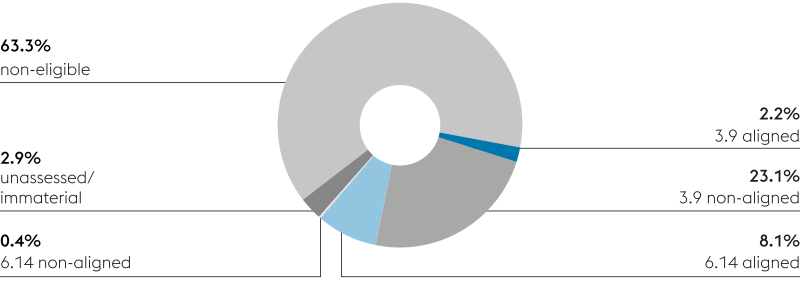
Unlike revenue and capital expenditure, the figure for operating expenditure cannot be taken directly from the annex notes of this Annual Report. This is because only a few expense categories are relevant to the determination of the denominator for the operating expenditure. These include building renovation measures, maintenance and repair of property, plant and equipment, research and development expenses, training expenses for employees, and current leasing expenses. This training expenditure also includes training necessary to operate installations and processes in a sustainable and compliant manner (including occupational safety or production process training in the context of taxonomy-eligible/aligned activities). The numerator includes OpEx that relates to assets or processes that are associated with taxonomy-eligible or taxonomy-aligned economic activities. OpEx from taxonomy-aligned economic activities amounted to EUR 102.1 million. This corresponds to 10.3% of OpEx according to the EU Taxonomy Regulation.
The taxonomy-aligned OpEx of EUR 102.1 million is made up of expenses for research and development of EUR 24.8 million, building renovation measures of EUR 11.2 million, current leasing of EUR 2.1 million, maintenance and repair of property, plant and equipment of EUR 59.5 million, and staff training of EUR 4.5 million. The total OpEx of EUR 993.0 million is made up of expenses for research and development of EUR 221.6 million, building renovation measures of EUR 35.0 million, current leasing of EUR 10.3 million, maintenance and repair of property, plant and equipment of EUR 693.2 million, and staff training of EUR 32.9 million. In addition to training for employees who maintain machinery, training for employees in production is also included in the training expenditure.
This leads to the following classification for the voestalpine Group:
2025/26 |
|
|
|
|
|
|
|
|
|
Taxonomy-aligned activities by environmental objective |
|
|
|
|
|
|
||||||||||
|---|---|---|---|---|---|---|---|---|---|---|---|---|---|---|---|---|---|---|---|---|---|---|---|---|---|---|
Economic activities |
|
Code |
|
Taxonomy-eligible OpEx |
|
Taxonomy-aligned OpEx |
|
Taxonomy-compliant OpEx |
|
Climate change mitigation |
|
Climate change adaptation |
|
Water |
|
Circular economy |
|
Pollution |
|
Biodiversity |
|
Enabling activity |
|
Transition activity |
|
Taxonomy-aligned share of taxonomy-eligible activities |
|
|
|
|
|
|
|
|
|
|
|
|
|
|
|
|
|
|
|
|
|
|
|
|
|
|
|
Manufacture of iron and steel |
|
CCM 3.9/CCA 3.9 |
|
25.3% |
|
21.5 |
|
2.2% |
|
2.2% |
|
0.0% |
|
0.0% |
|
0.0% |
|
0.0% |
|
0.0% |
|
|
|
T |
|
8.6% |
Infrastructure for rail transport |
|
CCM 6.14/CCA 6.14 |
|
8.5% |
|
80.6 |
|
8.1% |
|
8.1% |
|
0.0% |
|
0.0% |
|
0.0% |
|
0.0% |
|
0.0% |
|
E |
|
|
|
95.7% |
Total alignment by objective |
|
|
|
|
|
|
|
|
|
10.3% |
|
0.0% |
|
0.0% |
|
0.0% |
|
0.0% |
|
0.0% |
|
|
|
|
|
|
Total OpEx |
|
|
|
33.8% |
|
102.1 |
|
10.3% |
|
10.3% |
|
0.0% |
|
0.0% |
|
0.0% |
|
0.0% |
|
0.0% |
|
8.1% |
|
2.2% |
|
30.5% |