
ESRS E1 Climate change
ESRS E1 – Climate change
| Disclosure requirement | Name with reference | |
|
SBM-3 |
Material impacts, risks, and opportunities and their interaction with strategy and business model |
|
|
E1-1 |
||
|
E1-2 |
||
|
E1-3 |
Actions and resources in relation to climate change policies |
|
|
E1-4 |
||
|
E1-5 |
||
|
E1-6 |
||
|
E1-9 |
Anticipated financial effects from material physical and transition risks and potential climate-related opportunities (Transitional provision under ESRS used) |
Climate change is one of the greatest challenges of our time and requires companies to take decisive action. voestalpine is one of Austria’s largest emitters of greenhouse gas and consequently needs to drastically curb its emissions. In order to reduce its carbon footprint, voestalpine is focusing on transforming production processes by relying on technological innovations, strategic investments, and close cooperation with customers and suppliers.
With regard to Scope 1 and Scope 2 emissions, a key component of the Climate Transition Plan is the greentec steel climate protection program, which envisages the switch from coal-based blast furnaces to electric arc furnaces (EAF).
In addition to the technological transformation, supplier engagement is also playing an increasingly crucial role. Sustainable sourcing of raw materials and transparent supply chains are key drivers when it comes to bringing down total Scope 3 emissions. This presents both challenges and economic opportunities, particularly in light of the growing demand for low-emission steel products. At the same time, structural change continues to go hand in hand with high investment costs and market risks.
Climate change mitigation, climate change adaptation, and a sustainable energy supply are key challenges of our time. voestalpine takes an active approach toward these issues. Technological innovations, energy efficiency measures, and the gradual transition to renewable energy sources play a decisive role in this regard. Detailed information on the identified impacts, risks, and opportunities (IROs) in relation to climate change mitigation, climate change adaptation, and energy can be found in the following IRO table, which contains specific information on SBM‑3.
Topic/sub‑topic |
|
|
|
Impact, risk, opportunity (IRO) |
|
Description |
|
Value chain |
|
Time horizon |
|
Affected stakeholders |
|
|
|
|
|
|
|
|
|
|
|
|
|
Climate change mitigation |
|
|
|
GHG emissions |
|
GHG emissions from process-related activities in voestalpine’s own operations as well as from the upstream and downstream value chain, such as the procurement of raw materials including iron ore or coking coal, have negative impacts on the environment and society. The vast majority of Scope 1 emissions are generated through the manufacture of steel products at the Group’s largest sites in Linz and Donawitz. Scope 2 emissions resulting from the purchase of external energy are significantly lower in comparison. Scope 3 emissions comprise indirect emissions from the upstream and downstream value chain, more than 80% of which are due to the procurement of raw materials. |
|
▶▶▶ |
|
|
|
|
|
|
|
Technological developments & job infrastructure |
|
By expanding its investments in climate-friendly facilities, voestalpine is providing further impetus for decarbonization among other market participants. This creates strong incentives for the development of breakthrough technologies and production innovations that support a low-carbon economy. As a result, in addition to environmentally sustainable infrastructure, new, skilled jobs are being created within the industry’s economic environment, positively impacting the environment and climate change mitigation in turn. |
|
▶▷▶ |
|
|
|
|
|
|
ǃ |
|
Transition risk: technical transition to low-emission technologies |
|
The shift towards low-emission steel production within the scope of greentec steel requires voestalpine to make considerable investments in new technologies and facilities, which are being made under legal frameworks that remain uncertain to some extent, e.g., uncertainties regarding the design of protective measures such as the Carbon Border Adjustment Mechanism (CBAM) and the future allocation of free allowances. The lack of a uniform, generally accepted definition of green steel also increases the risk of further cost increases. At the same time, the introduction and ramp-up of new production processes are accompanied by operational risks, such as lower efficiencies in the initial phases, which can only be optimized by increasing operational experience, or temporary operational downtime. |
|
▷▶▷ |
|
|
|
|
|
|
ǃ |
|
Transition risk: costs arising from carbon pricing |
|
Carbon pricing mechanisms such as the EU Emissions Trading Scheme (ETS) and the Carbon Border Adjustment Mechanism (CBAM) are creating increasing financial burdens, potentially resulting in competitive disadvantages compared to non-EU competitors, and triggering structural changes in industry, such as the relocation of downstream industries and higher price competition. |
|
▶▶▶ |
|
|
|
|
|
|
✚ |
|
Transition opportunity: |
|
Growing demand and corresponding price premium for low-emission steel. This can also lead to a stronger market position in specialized segments such as rail infrastructure systems, special steels, and high-performance materials. |
|
▷▶▶ |
|
|
|
|
|
|
ǃ |
|
Transition risk: supply bottlenecks and higher costs for important materials and raw materials |
|
Due to the transformation, demand for critical raw materials such as steel scrap, special metals, and alloys is rising, resulting in a higher risk of supply bottlenecks. voestalpine is facing growing demand that could potentially lead to production delays or quality risks. At the same time, considerable price volatility makes planning more difficult and reduces investment security. |
|
▶▶▷ |
|
|
|
|
|
Climate change adaptation |
|
ǃ |
|
Physical climate risks |
|
Physical risks can impact voestalpine’s business in a number of ways. Material acute physical risks include heavy rain, floods, and landslides. Chronic physical risks include substantial variations in river water levels due to climate change, which can disrupt shipping (e.g., on the Danube) and result in supply chain disruptions. |
|
▶▶▶ |
|
|
|
|
Energy |
|
ǃ |
|
Transition risk: bottlenecks in the energy supply and higher costs for energy procurement |
|
This transition risk for voestalpine comprises bottlenecks in the energy supply at major production sites (in particular Linz and Donawitz), and higher costs for energy procurement (renewable and non-renewable sources) due to the energy transition in Europe. This risk is driven above all by volatile energy markets and potential shortages. |
|
▶▶▷ |
|
|
|
|


|
||||||||||||||||||||||||||||||||||||||||||||||||||||||||

Strategy
E1‑1 – Transition plan for climate change mitigation
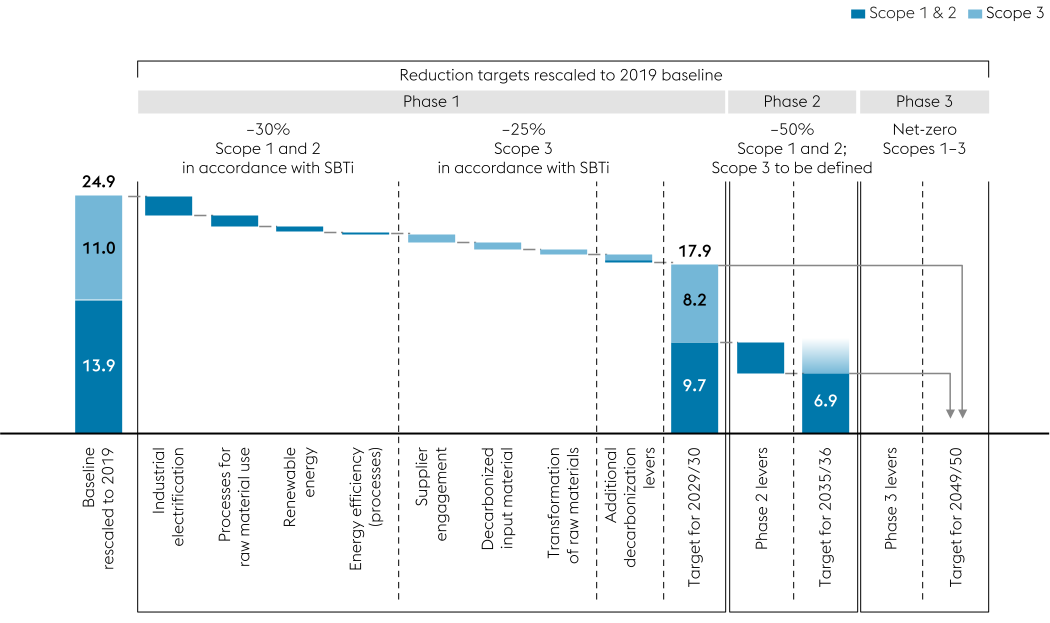
voestalpine aims to extensively reduce its greenhouse gas (GHG) emissions across its entire value chain and is committed to lowering its emissions in line with the scientifically validated 2 degree climate target as part of the Science Based Targets Initiative (SBTi). By calendar year 2029, Scope 1 and Scope 2 emissions are to be reduced by 30% and Scope 3 emissions by 25%. The targets set have been tested and validated by the SBTi and align with efforts to limit global warming set forth in the Paris Agreement.
As part of ESRS-compliant reporting, the basis for the calculation of the GHG footprint has been changed from the calendar year to the business year. Accordingly, the emission reduction targets stated in the Climate Transition Plan are presented on a business year basis. However, the targets up to 2029 validated by the Science Based Targets initiative (SBTi) continue to be calculated on the basis of the calendar year.
voestalpine’s long-term climate transition plan is divided into three implementation phases: phase 1 (by business year 2029/30), phase 2 (by business year 2035/36), and phase 3 (by business year 2049/50).
It includes a long-term target of limiting global warming to 1.5°C by 2050, while the validated targets in phase 1 by business year 2029/30 follow a “well below 2°C” reduction pathway. voestalpine also pursues the medium-term target of reducing its Scope 1 and Scope 2 emissions by 50% by business year 2035/36 in phase 2, and achieving net-zero emissions in the long term by business year 2049/50 at the latest in phase 3.
In order to achieve the targets set forth in its strategy and the implementation of the Climate Transition Plan, voestalpine is relying on various decarbonization levers that cover the entire value chain and facilitate the transition to lower-emission steel production.
The decarbonization levers are already clearly defined in phase 1. These include industrial electrification, with coal-based blast furnaces replaced by electric arc furnaces (EAF) as the primary measure; the use of renewable energies to reduce CO2 emissions; the use of raw materials in iron and steel production processes; and improving energy efficiency in production processes and infrastructure. The supply chain is also actively involved in the decarbonization process through measures such as increasingly relying on CO2-reduced input materials and optimizing the use of raw materials. For more information please see E1‑3.
Phase 2 and phase 3 will be specified in more detail over time, but their primary aims are to extensively transform processes and to fully decarbonize and offset remaining emissions.
The transformation of the production processes in phase 1 of the Climate Transition Plan will facilitate the production of up to 2.5 million tons of low-emission steel, which in turn will enable the sustainable development and adaptation of business models to regulatory requirements and growing market demand for climate-friendly products. Production capacities for low-emission steel will be gradually increased in phases 2 and 3.
The first stage of the plan and the necessary financial resources, namely a EUR 1.5 billion investment budget, have been approved by the Management Board and Supervisory Board.
The financial resources required to implement phase 1 of the transformation have been taken into account in the medium-term business plan. Over the coming years, voestalpine plans to make targeted investments in low-emission technologies and energy-efficient installations. All required investments are quantified on a regular basis in order to ensure the transformation is economically sustainable. Detailed information on CapEx plans and KPIs can be found under E1‑3 and in the chapter on Disclosures required by the EU Taxonomy Regulation.
Emissions data is collected annually, verified externally, and compared against the defined targets as part of this assessment. Technological advancements, legislative changes, and market conditions are accounted for in the assessment in order to adapt and further develop the transition plan if necessary.
The sustainability strategy constitutes an integral part of the Group’s strategy, uniting economic, social, and environmental aspects and targets. In order to achieve the objectives set forth in its strategy, voestalpine is relying on central decarbonization levers that facilitate the transition to lower-emission steel production.
Investments and funding supporting climate change mitigation and climate change adaptation
In order to utilize the decarbonization levers as part of its decarbonization sustainability strategy and the EU Taxonomy, voestalpine launched a five-year CapEx plan in the business year 2023/24. Around EUR 1.5 billion has already been approved by the Supervisory Board for the electric arc furnaces in Linz and Donawitz as part of phase 1 of the greentec steel climate protection program, which forms a key component of the company’s Climate Transition Plan. Of this, around EUR 0.9 billion had already been invested by the end of the 2025/26 business year (by 2024/25: around EUR 0.5 billion). In addition, further investments for the ongoing replacement of fossil pig iron capacity and CCUS technologies (phase 2) are taken into account in the financial plans for reviewing the recoverability of non-current assets in the affected production units of the Steel and Metal Engineering Division (for details see B.2. Significant judgments and estimates and B.3. Significant accounting policies in the notes to the Consolidated Financial Statements).
The plan focuses on decarbonization levers for all phases, which make a significant contribution to the transformation towards more climate-friendly production. The decarbonization levers required to achieve the Scope 1 to 3 targets in phase 1 are clearly defined and quantified at this stage. As things currently stand, all related steps are progressing as scheduled without any delays. The investments are closely linked to the requirements of disclosure requirement E1‑3 and support both the achievement of the long-term climate targets and safeguarding voestalpine’s competitive standing in the global market. The decarbonization levers for Scope 1 to 3 emissions in phases 2 and 3 are being specified and defined as part of a continuous development process.
The company has provided significant investments and funding to successfully realize its transition plan for decarbonization. voestalpine has also received funding commitments in the region of EUR 90 million to finance investments in electric arc furnace technology and further research activities. These funds come from the Transformation of Industry program funded by the Austrian Federal Government and support the implementation of central decarbonization levers.
CapEx from taxonomy-aligned activities is used as a key performance indicator to measure the progress of the actions as part of the decarbonization levers. In the current business year, a total of EUR 381.8 million of CapEx was reported as taxonomy-aligned (see also the chapter on Disclosures required by the EU Taxonomy Regulation), where EUR 303.3 million is attributed to the economic activity 3.9 Manufacture of iron and steel, of which, in turn, EUR 292.7 million represents greentec steel investments. No significant CapEx amounts were invested during the reporting period in relation to coal, oil, and gas-related economic activities.
Back in 2024, voestalpine laid the foundation for the issuance of green bonds and other green financing instruments with the launch of the Green Financing Framework. voestalpine was the first European steel company to publish its Green Financing Framework. On October 3, 2024, voestalpine AG issued a fixed interest green bond of EUR 500.0 million. 100% of the proceeds from the issue will be used to refinance or finance sustainable voestalpine projects such as greentec steel.
voestalpine’s GHG emissions can primarily be attributed to the continued operation of existing installations, including blast furnace-based steel production. These installations are integrated into existing production processes and represent important assets. Moving away from this technology is therefore technically and economically challenging, but will nevertheless be taken into account in the long-term voestalpine Climate Transition Plan. As phase 1 of the greentec steel project, voestalpine plans to replace two blast furnaces with electric arc furnaces (EAFs) by 2029/30 to reduce GHG emissions. In phase 2, voestalpine plans to replace additional blast furnace-based production capacities at its crude steel production sites, and consequently the associated GHG emissions. The transformation of the production facilities in phase 2 represents a transitional step towards a 1.5°C reduction pathway. At the Donawitz site, the complete transformation of blast furnace-based production in this phase will reduce the amount of locked-in GHG emissions to a minimum. Net-zero emissions are to be achieved through the transformation of voestalpine’s remaining production capacity in phase 3.
The associated transition risks were analyzed by voestalpine; please refer to ESRS 2 IRO‑1 for more information. After the above actions have been taken, any remaining GHG emissions have been accounted for in the Climate Transition Plan and do not jeopardize the achievement of the set emission reduction targets.
In addition to the analysis of aspects pertaining to GHG emissions in relation to assets and products, compliance with regulatory criteria related to climate-related benchmarks must also be assessed, with voestalpine falling under the Paris-aligned European Union benchmarks. This disclosure requirement is consistent with the requirements of Commission Implementing Regulation (EU) 2022/2453 and Commission Delegated Regulation (EU) 2020/1818 on climate-related benchmarks.
Impact, risk, and opportunity management
E1‑2 – Policies related to climate change mitigation and adaptation
As part of its sustainability strategy, voestalpine is committed to reducing GHG emissions as one of its key focus areas. Specific impacts, risks, and opportunities form the primary focus in order to account for both climate change mitigation and efficient, sustainable energy use. Key concepts include:
- a Climate Transition Plan for decarbonization
- the Environmental Policy
The Climate Transition Plan and the Environmental Policy are closely linked to voestalpine’s sustainability strategy and support the company’s long-term competitive standing. The implementation of the greentec steel program, namely the phased transformation of crude steel production processes, within the framework of the Climate Transition Plan facilitates the sustainable development of the core business by gradually introducing low-emission technologies and optimizing existing processes. This ensures that steel production meets both the regulatory requirements and the increasing market requirements for climate-friendly products. For more information, see chapter E1‑1.
The Climate Transition Plan covers the company’s own operations (Group-wide production and sales sites worldwide) as well as selected areas of the upstream and downstream value chain, such as purchased energy and procured goods and services (raw materials). The Environmental Policy for the voestalpine Group is an overarching environmental framework that sets out principles and guidelines, including in relation to climate change mitigation and energy. It supports the companies in the implementation of measures to decarbonize their own processes and value chains.
The Climate Transition Plan also supports the increased integration of renewable energies and consequently the reduction of GHG emissions.
The data used for the Climate Transition Plan will be reviewed annually, updated where necessary, and progress towards target achievement evaluated. Environmental and energy management systems are audited and certified at regular intervals.
IROs addressed |
|
Policy |
|
Scope of the policy |
|
Responsibility and monitoring |
|
Other comments |
|
|
|
|
|
|
|
|
|
GHG emissions (Scope 1 to 3) |
|
Climate Transition Plan for decarbonization |
|
Own operations and (to a partial extent) upstream and downstream value chain |
|
Management Board and Supervisory Board of voestalpine AG |
|
|
GHG emissions (Scope 1 to 3) |
|
Environmental Policy |
|
Own operations and upstream and downstream value chain |
|
Management Board and Supervisory Board of voestalpine AG |
|
|
E1‑3 – Actions and resources in relation to climate change policies
As part of the Climate Transition Plan, voestalpine has developed a comprehensive package of actions to reduce Scope 1, 2, and 3 GHG emissions and to lower energy requirements. The decarbonization levers are applied throughout the Group. These actions revolve around the ambitious transformation program greentec steel, which is considered the central and currently most important measure for the decarbonization of the company.
Measures relating to the decarbonization levers had already been implemented by the reporting period. Other key measures, such as the planning and construction of the electric arc furnaces in Linz and Donawitz, are on track and currently being implemented.
Phase 1: Scope 1 & 2 decarbonization levers
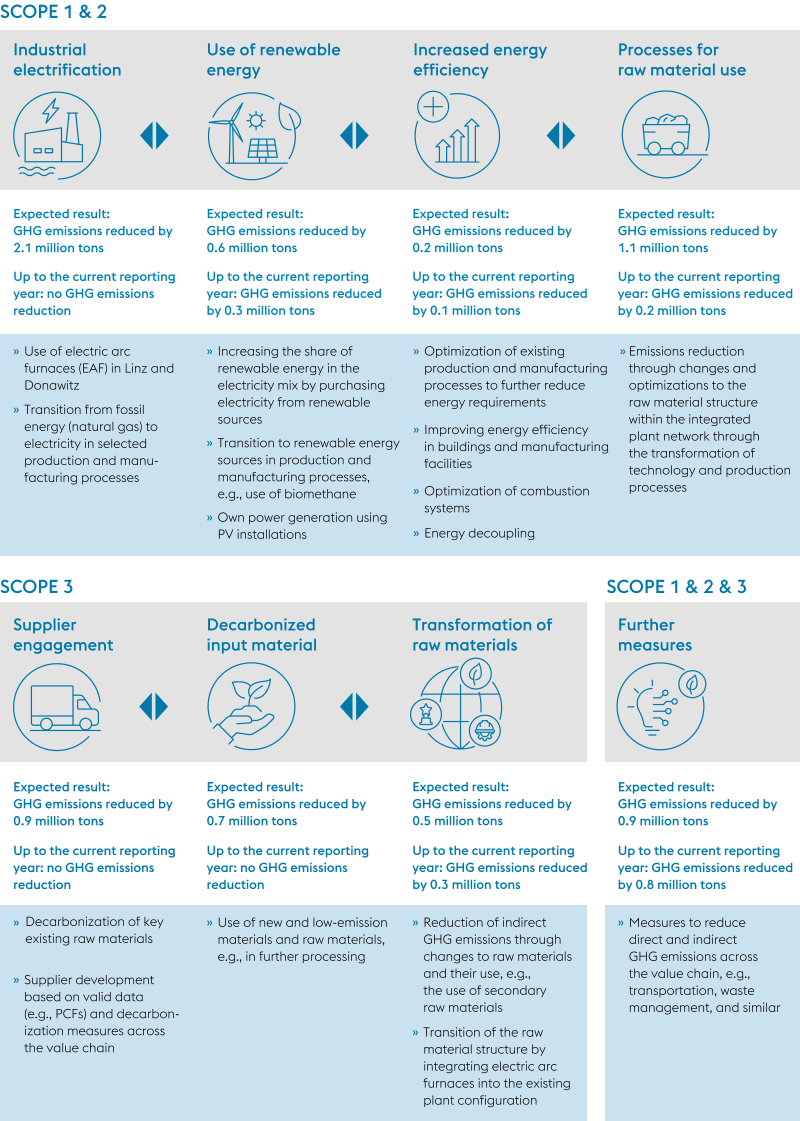
One important lever for Scope 1 and 2 emissions is industrial electrification, on which significant progress is being made thanks to greentec steel. As part of the first stage of the phased plan, one green electricity-powered electric arc furnace (EAF) will be built at the Linz site and one green electricity-powered EAF system at the Donawitz site. This involves a shift away from carbon-based processes towards an electrified, low-emission production method, accompanied by a fundamental transition in the use of raw materials in crude steel production. Depending on the quality requirements, a mix of input materials consisting of scrap, liquid pig iron, and HBI (hot briquetted iron) will be used. A mix of materials is used, comprising scrap, liquid pig iron, and hot briquetted iron (HBI), with the mix adjusted according to the specific quality requirements. voestalpine sources the necessary HBI primarily from the direct reduction plant in Texas, USA: since 2022, a global steel manufacturer has held a majority stake in the plant; 20% is owned by voestalpine with corresponding supply agreements guaranteed over the long-term. A phased transition of certain production processes from fossil fuels to electric energy sources is also planned, in particular to further reduce dependence on natural gas.
These actions are currently under implementation and the EAFs are scheduled to come into operation from 2027. Phase 1 of the greentec steel program therefore represents a key building block in the CapEx plan with significant capital expenditure of around EUR 1.5 billion, of which EUR 292.7 million has been reported as taxonomy-aligned in the business year 2025/26 (see also disclosures under E1‑1). The financial resources for the implementation of the measures under the greentec steel program from phase 1 were approved by the Supervisory Board back in March 2023.
Of the EUR 1.5 billion, EUR 0.9 million had already been invested by the end of the business year 2025/26 (of which EUR 0.4 million was invested during the business year 2025/26). The investment of EUR 0.4 million to implement the measures is included in the Consolidated Financial Statements in the additions to property, plant and equipment and intangible assets (for more information see D.9. Property, plant, and equipment, and D.10. Goodwill and other intangible assets, in the notes to the Consolidated Financial Statements).
Targeted measures to increase the use of low-emission energy sources have been identified under the renewable energies lever. These include, in particular, the purchase of green electricity and the use of biomethane. This lever for reducing GHG emissions supports the achievement of voestalpine’s climate targets up to the business year 2029/30 initially.
Increasing energy efficiency includes targeted measures such as optimizing production processes and improving the energy performance of manufacturing facilities and buildings with state-of-the-art technology. Another key aspect is the optimization of combustion systems and the efficient use of excess energy by decoupling energy for use in other applications, such as supplying heat to adjacent operating units or supplying external grids. Corresponding action is being financed and implemented within the framework of the investment programs and continuous improvement processes.
The lever processes for raw material use in Scope 1 and 2 takes into account that the transformation of technology and production processes and the associated adaptation of process control in the integrated plant network result in changes and opportunities for optimization in the structure of raw materials used, which contribute to reducing the GHG emissions.
Phase 1: Scope 3 decarbonization levers
voestalpine is focusing on taking targeted action within its value chain to bring down indirect Scope 3 GHG emissions by the business year 2029/30. A key decarbonization lever in this regard is supplier engagement, which includes decarbonizing key existing raw materials. This is based on the use of valid data, e.g., Product Carbon Footprints (PCFs) for key raw materials and corresponding decarbonization projects and measures within the value chain, as well as close cooperation with suppliers to reduce emissions (supplier development). The sustainable transformation is also supported by the gradual substitution of primary and secondary raw materials (e.g., scrap and other secondary raw materials), especially with regard to the interdependencies of future production with electric arc furnaces (EAFs).
One key measure for reducing Scope 3 GHG emissions is the planned use of decarbonized input materials, new low-emission raw materials and materials, for example in voestalpine’s further processing operations. This approach makes a significant contribution to the achievement of voestalpine’s climate targets by the business year 2029/30, as increased reliance on low-emission precursors has the power to reduce the company’s carbon footprint along the upstream and downstream value chain.
Phase 2 & 3: Scope 1 & 2 decarbonization levers
An important lever in phase 2 is the advancement of industrial electrification by continuing with progress on the transformation of steel production processes, for example by expanding production capacities through the electric steel route. Actions for this lever are being developed and put into practice. The use of carbon capture and storage technologies (CCUS) is designed to further reduce process-related emissions. The aim is to accelerate the decarbonization and gradual conversion of remaining energy to renewable energy sources by the business year 2035/36. voestalpine is working on further developing these technologies and applications on an industrial scale, building technical pilot plants, and implementing the latest findings from research and development.
Phase 3 marks the final step towards net-zero emissions by the business year 2049/50. As part of this long-term view, voestalpine is pursuing an approach that is open to different technology types and considers various solutions and technology options while simultaneously creating opportunities for the implementation of future advancements in technology and science to achieve net-zero emissions. Maximum flexibility and economic feasibility play a key role in this regard.
The focus is on replacing the remaining fossil pig iron capacity using fossil-free energy sources such as hydrogen, renewable energy, and the extensive application of CCUS technologies. In this context, future technology scenarios and the associated energy requirements for relevant energy sources were created in the 2025/26 business year.
Actions to counter physical climate risks
In addition to the actions set forth in the Climate Transition Plan, actions to counter physical climate risks are also currently being implemented. One example is the construction of flood protection at Unterer Tollinggraben, near the Donawitz site. Activities are also being undertaken to counteract the impacts of long-term fluctuations in river levels, such as diversifying supply routes and making adjustments to logistics in the case of low water levels.
Further activities relating to transition risk: costs arising from carbon pricing
voestalpine counters this risk by means of targeted investment as part of a gradual transformation of production processes. In addition, the Group is focusing on increased differentiation in product quality, flexibility, and service. voestalpine’s growing internationalization in high-yield processing fields based on the local for local principle likewise helps to safeguard the company’s competitive standing.
IROs addressed |
|
Action |
|
Time horizon |
|
Scope of the action |
|
Significant expenditure (if relevant)/other comments |
|
|
|
|
|
|
|
|
|
GHG emissions (Scope 1 to 3) |
|
Phased implementation for the transformation |
|
Implementation by the BY 2029/30, commissioning of EAFs in Linz and Donawitz in 2027 |
|
Own operations and (to a partial extent) upstream and downstream value chain |
|
CapEx greentec steel phase 1: EUR 1.5 billion |
Transition risk: supply bottlenecks and higher costs for important materials and raw materials |
|
Actions to account for transition risks arising from resource bottlenecks in relation to decarbonization |
|
Ongoing implementation |
|
Own operations |
|
|
Physical climate risks |
|
Actions to counter physical risks |
|
Project-dependent |
|
Own operations |
|
CapEx according to investment program |
Metrics and targets
E1‑4 – Targets related to climate change mitigation and adaptation
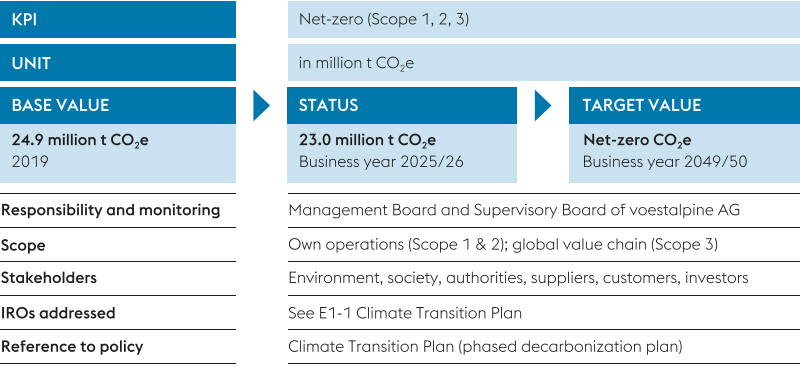
voestalpine has been committed to setting ambitious targets for reducing GHG emissions since 2022 as part of the Science Based Targets Initiative (SBTi). The set GHG emission reduction targets are gross targets and do not envisage GHG removals, carbon credits, or avoided emissions. More specifically, voestalpine pursues the near-term target of reducing its Scope 1, 2, and 3 emissions and achieving net-zero emissions in the long term, by the business year 2049/50 at the latest.
In order to achieve this target, voestalpine is initially committed to a science-based 2°C reduction pathway (well-below 2°C) in accordance with the SBTi in phase 1, which aligns with the Paris Agreement and supports global efforts to limit global warming. The current Climate Transition Plan includes a long-term target to limit global warming to 1.5°C up to business year 2049/50 (see E1‑1). GHG reductions are to be progressively developed and implemented in phases 2 and 3, moving towards a 1.5°C reduction pathway.
The reduction targets were validated in 2023 on the basis of the general, non-sector-specific SBTi reduction path (absolute contraction approach). The targets up to 2029 validated by the Science Based Targets initiative (SBTi) continue to be calculated on the basis of the calendar year. As part of ESRS-compliant reporting, the basis for the calculation of the GHG footprint has been changed from the calendar year to the business year. Accordingly, the emission reduction targets are presented on a business year basis. A sector-specific decarbonization pathway has not been incorporated to date as there was no relevant pathway available for the steel industry at the time the targets were set. The SBTi is based on established climate and policy scenarios published by the IAMC, IPCC, and IEA in accordance with the Paris Agreement for the validation and development of emission reduction targets. Climate risks were accounted for when the targets were set.
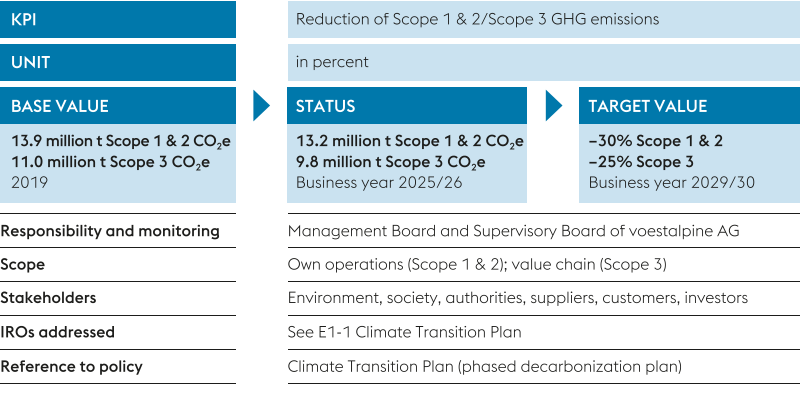
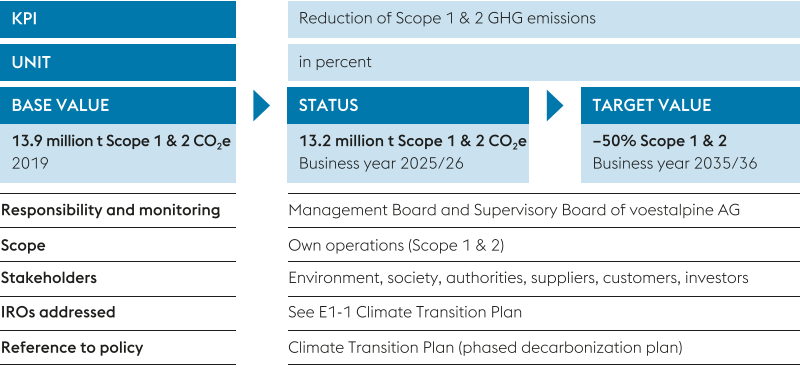
More specifically, the company is committed to reducing its Scope 1 and Scope 2 emissions by 30% and its Scope 3 emissions by 25% by calendar year 2029 as part of the SBTi. The GHG emissions covered and the respective shares of Scopes 1 to 3 are explained in E1‑6. voestalpine also pursues the medium-term target of reducing its Scope 1 and Scope 2 emissions by 50% by business year 2035/36 and achieving net-zero emissions in the long term by the business year 2049/50 at the latest. The system boundaries for the targets are the same as those used for GHG accounting under E1‑6.
The Scope 2 GHG emissions used to calculate this target were calculated using the market-based methodology.
SBTi’s validation of the 2029 reduction target ensured that the targets were consistent with the company’s greenhouse gas inventory limits. The targets were subsequently published, including as part of the Carbon Disclosure Project (CDP).
The base year for tracking progress on target attainment was defined as calendar year 2019. Based on the requirements of the GHG Protocol and the SBTi, a standardized procedure for reviewing and, if necessary, adjusting the GHG footprint for the reference year was developed in the reporting period.
An assessment took place on the basis of five defined categories and thresholds to determine whether a rescaling of the initial calculations is necessary, for example due to structural changes in the Group, methodological developments, or new scientific findings. In the business year 2024/25, a rescaling was carried out and the GHG footprint for 2019 was recalculated. voestalpine has verified the validation of existing targets through calendar year 2029 with the SBTi. In business year 2025/26, no rescaling of the GHG footprint for the reference year is necessary.
The set GHG emission reduction targets pertain to the material impacts, opportunities, and risks related to climate change mitigation, climate change adaptation, and reducing the physical climate risks and transition risks to which voestalpine is exposed. Progress has been made on the targets with the divisions and the Head of Sustainability Management at voestalpine.
The GHG emission reduction targets are integrated into the voestalpine Decarbonization Climate Transition Plan, which is explained in detail in E1‑1. To achieve the targets, voestalpine has defined various decarbonization levers that cover both Scope 1 and Scope 2 emissions as well as Scope 3 emissions. These levers are also described as part of the Climate Transition Plan under E1‑1. Their overall quantitative contribution to achieving the GHG emission reduction targets is described in a detailed list of individual actions under E1‑3.
The targets are developed through an ongoing and extensive dialogue with voestalpine’s various internal and external stakeholders and reflect their current requirements.
Near-term targets |
|
Rescaled in 2019 |
|
Business year 2029/30 |
|
|
|
|
|
Scope 1 & 2 |
|
13.9 |
|
9.7 |
Scope 3 |
|
11.0 |
|
8.2 |
E1‑5 – Energy consumption and mix
As an energy-intensive company, voestalpine views sustainable energy management as an indispensable part of its corporate strategy. Continuous process optimization has resulted in efficiency gains.
Moving forward, technological transformations, in particular the use of electric arc furnaces (EAF), will help the company make further progress in this regard. A further reduction in fossil fuels is to be achieved on the one hand by increasing the proportion of renewable energies, and on the other hand by further efficiency increases in all production processes. These initiatives contribute both to global climate protection and to securing the company’s long-term competitiveness.
The Group’s total energy consumption from processes in high climate impact sectors owned and controlled by the company is presented in the table below. The system limits are applied as described in E1‑6.
|
|
2024/25 |
|
2025/26 |
|
|
|
|
|
Fossil feedstocks for metallurgical processes |
|
|
|
|
0) Use of coal and coal products for metallurgical processes (MWh) |
|
26,672,394 |
|
28,181,886 |
|
|
|
|
|
Fossil energy |
|
|
|
|
1) Fuel consumption from coal and coal products (MWh) |
|
170 |
|
199 |
2) Fuel consumption from crude oil and petroleum products (MWh) |
|
190,994 |
|
202,272 |
3) Fuel consumption from natural gas (MWh) |
|
6,127,776 |
|
6,007,526 |
4) Fuel consumption from other fossil sources (MWh) |
|
7,556 |
|
334 |
5) Consumption of purchased or acquired electricity, heat, steam, and cooling from fossil sources (MWh) |
|
942,276 |
|
799,250 |
6) Total fossil energy consumption (MWh) |
|
7,268,772 |
|
7,009,581 |
Share of fossil sources in total energy consumption (%) |
|
82 |
|
82 |
|
|
|
|
|
Nuclear energy |
|
|
|
|
7) Consumption from nuclear sources (MWh) |
|
223,822 |
|
171,728 |
Share of consumption from nuclear sources in total energy consumption (%) |
|
3 |
|
2 |
|
|
|
|
|
Renewable energy sources |
|
|
|
|
8) Fuel consumption for renewable sources, including biomass (also comprising industrial and municipal waste of biologic origin, biogas, renewable hydrogen, etc.) (MWh) |
|
67,306 |
|
77,839 |
9) Consumption of purchased or acquired electricity, heat, steam, and cooling from renewable sources (MWh) |
|
1,149,954 |
|
1,118,933 |
10) The consumption of self-generated non-fuel renewable energy (MWh) |
|
143,069 |
|
167,841 |
11) Total renewable energy consumption (MWh) |
|
1,360,329 |
|
1,364,613 |
Share of renewable sources in total energy consumption (%)) |
|
15 |
|
16 |
|
|
|
|
|
Total energy consumption (MWh) |
|
8,852,923 |
|
8,545,922 |
including fossil energy for metallurgical processes (MWh) |
|
35,525,317 |
|
36,727,808 |
The total energy consumption shown includes fossil energy for metallurgical processes, such as reducing agents for the blast furnace process, and energy from fuels.
voestalpine generates electricity in its captive power plants from process gases and uses it to drive both the production process and the downstream processing steps. This enables the Group to cover a large part of its electricity requirements from its own generation. voestalpine currently also uses renewable energy such as hydropower and photovoltaics. Generation from renewable sources amounts to 167,841 MWh (2024/25: 143,069 MWh), while generation from non-renewable sources comes to 1,392,586 MWh (2024/25: 1,469,741 MWh).
Energy intensity based on net revenue
voestalpine operates in several high climate impact sectors which incur significant energy consumption and GHG emissions. According to regulation (EC) No 1893/2006 (NACE regulation), these include:
- C—Manufacturing
- G—Wholesale and Retail Trade; Repair of Motor Vehicles and Motorcycles
- H—Transport and Storage; and
- L—Real Estate Activities
The revenues of the entire Group were analyzed and compared with revenues in high climate impact sectors in order to assess the energy intensity of the climate-intensive activities.
Energy intensity per net revenue |
|
2024/25 |
|
2025/26 |
|
|
|
|
|
Total energy consumption from activities in high climate impact sectors (MWh) |
|
8,852,923 |
|
8,545,922 |
Net revenue from activities in high climate impact sectors (EUR million) |
|
15,705.0 |
|
15,020.9 |
Total energy consumption from activities in high climate impact sectors per net revenue from activities in high climate impact sectors (MWh/EUR million) |
|
564 |
|
569 |
In millions of euros |
|
2024/25 |
|
2025/26 |
|
|
|
|
|
Net revenue from activities in high climate impact sectors used to calculate energy intensity |
|
15,705.0 |
|
15,020.9 |
Net revenue (other) |
|
38.7 |
|
42.2 |
Total net revenue (Consolidated Financial Statements) |
|
15,743.7 |
|
15,063.1 |
ESRS disclosure requirement |
|
Paragraph |
|
Datapoint/metric |
|
Basis for the preparation and description of the assumptions and methodology |
|
Information on sources of a high level of measurement uncertainty and information on measurement |
|
|
|
|
|
|
|
|
|
E1‑5 – Energy consumption and mix |
|
37–38 |
|
Total energy consumption |
|
Aggregation of energy consumption from the Group companies collected as part of the Group-wide data collection |
|
Sources of measurement uncertainty relate to the energy collection systems in place at the Group companies and the extrapolation of quarterly figures |
E1‑5 – Energy consumption and mix |
|
40 |
|
Energy intensity |
|
Calculation of energy intensity based on reported total energy consumption and reported net revenue |
|
No further uncertainty |
E1‑6 – Gross Scope 1, 2 and 3 and Total GHG emissions
voestalpine calculates its company-specific GHG footprint in accordance with the provisions of the Greenhouse Gas Protocol using primary data, databases (Sphera LCAFE Content Version 2026.1), and value chain information. Modeling is based on recognized methods and is applied Group-wide for production and sales locations worldwide. The evaluation methodology “EF 3.1 Climate change total” was applied for this reporting year.
Data collection, GHG modeling, and the presentation of findings are subject to external verification in accordance with ISO 14064‑3. The GHG reporting system limits correspond to the voestalpine consolidation limits (see Consolidated Financial Statements) and include domestic and foreign fully consolidated companies over which voestalpine exercises operational control, taking into account materiality limits for Scope 1 and Scope 2 emissions in GHG accounting. The materiality assessment identified the most significant Scope 3 categories. In the 2024/25 business year, the base year for the GHG reduction targets was rescaled and the GHG footprint for 2019 was recalculated. In business year 2025/26, no rescaling of the GHG footprint for the reference year is necessary.
voestalpine’s GHG emissions have been compiled in consideration of reporting periods that may differ from those of some companies in the value chain. In the case of relevant events and changes affecting emissions between different reporting periods, the corresponding events and changes are taken into account. No significant deviations or changes are known at present.
The GHG footprint of voestalpine AG is divided into three areas referred to as scopes:
- Scope 1: direct emissions from internal or controlled sources
- Scope 2: indirect emissions from the generation of purchased energy, both market and location-based, consumed by the company
- Scope 3: indirect emissions along the upstream and downstream value chain
Scope 3 GHG emissions are largely based on secondary data, as primary data from suppliers or other partners in the value chain is not yet available in the comprehensive quality required. The scopes shown cover carbon emissions and other climate-relevant GHG emissions in accordance with the Kyoto Protocol and the GHG Protocol standard. Accordingly, Scope 3 emissions of consolidated entities are taken into account, whereas Scope 3 emissions of non-consolidated entities are not taken into account. For other entities in the value chain, indirect emissions are taken into account in category 1 “purchased goods.” All emission levels are reported in CO2 equivalents (CO2e).
When compiling voestalpine’s GHG footprint, double counting of emissions in Scopes 1 and 3 is avoided.
|
|
Retrospective |
|
Milestones and target years |
|||||||||||||
|
|
Base year |
|
Comparative year |
|
Current BY |
|
% N/N-1 |
|
Near- term target |
|
Long- term target |
|
Annual % of target/ |
|||
|
|
2019 |
|
2024/25 |
|
2025/26 |
|
|
|
2029/30 |
|
2049/50 |
|
||||
|
|
|
|
|
|
|
|
|
|
|
|
|
|
|
|||
Scope-1-GHG emissions |
|
|
|
|
|
|
|
|
|
9.7 |
|
Net-zero emissions |
|
3.0 |
|||
Gross Scope 1 GHG emissions (million t CO2e) |
|
12.8 |
|
12.1 |
|
12.6 |
|
104 |
|
|
|
||||||
Percentage of Scope 1 GHG emissions from regulated emission trading schemes (%) |
|
98 |
|
98 |
|
98 |
|
100 |
|
|
|
||||||
Scope-2-GHG emissions |
|
|
|
|
|
|
|
|
|
|
|
||||||
Gross location-based Scope 2 GHG emissions (million t CO2e) |
|
0.5 |
|
0.611 |
|
0.51 |
|
84 |
|
|
|
||||||
Gross market-based Scope 2 GHG emissions (million t CO2e) |
|
1.1 |
|
0.781 |
|
0.55 |
|
71 |
|
|
|
||||||
Significant Scope-3-GHG emissions |
|
|
|
|
|
|
|
|
|
8.2 |
|
|
2.5 |
||||
Total gross indirect (Scope 3) GHG emissions (million t CO2e) |
|
11.0 |
|
9.91 |
|
9.8 |
|
99 |
|
|
|
||||||
3.1 Purchased goods and services |
|
9.3 |
|
8.3 |
|
8.2 |
|
99 |
|
|
|
||||||
3.2 Capital goods |
|
– |
|
0.111 |
|
0.06 |
|
55 |
|
|
|
||||||
3.3 Fuel and energy-related activities (not included in Scope 1 or Scope 2) |
|
0.7 |
|
0.5 |
|
0.5 |
|
100 |
|
|
|
||||||
3.4 Upstream transportation and distribution |
|
0.6 |
|
0.6 |
|
0.6 |
|
100 |
|
|
|
||||||
3.5 Waste generated in operations |
|
0.03 |
|
0.03 |
|
0.03 |
|
100 |
|
|
|
||||||
3.6 Business travel |
|
not relevant |
|
|
|
||||||||||||
3.7 Employee commuting |
|
not relevant |
|
|
|
||||||||||||
3.8 Upstream leased assets |
|
not relevant |
|
|
|
||||||||||||
3.9 Downstream transportation |
|
0.4 |
|
0.4 |
|
0.4 |
|
100 |
|
|
|
||||||
3.10 Processing of sold products |
|
not relevant |
|
|
|
||||||||||||
3.11 Use of sold products |
|
not relevant |
|
|
|
||||||||||||
3.12 End-of-life treatment of sold products |
|
not relevant |
|
|
|
||||||||||||
3.13 Downstream leased assets |
|
not relevant |
|
|
|
||||||||||||
3.14 Franchises |
|
not relevant |
|
|
|
||||||||||||
3.15 Investments |
|
not relevant |
|
|
|
||||||||||||
Total GHG emissions |
|
|
|
|
|
|
|
|
|
|
|
|
|
|
|||
Total GHG emissions (location-based) (million t CO2e) |
|
24.3 |
|
22.61 |
|
22.9 |
|
101 |
|
|
|
|
|
|
|||
Total GHG emissions (market-based) (million t CO2e) |
|
24.9 |
|
22.81 |
|
23.0 |
|
101 |
|
17.9 |
|
Net-zero |
|
|
|||
|
|
|
|
|
|
|
|
|
|
|
|
|
|
|
|||
|
|||||||||||||||||
Scope 1 emissions
voestalpine’s Scope 1 direct greenhouse gas emissions come from its own companies and sites, the majority of which are emitted in Austria at its Linz and Donawitz sites. 98% (2024/25: 98%) of these total Scope 1 emissions come from plants covered by the EU Emissions Trading System (ETS).
During this reporting period, biogenic CO2 emissions from the combustion of biomethane and biochar, amounting to 0.017 million t CO2e, are reported for the first time. Since this information was not available in the previous reporting period, it is not possible to present a comparative figure or year-on-year change for this metric.
Scope 1 emissions at voestalpine are not calculated to include carbon credits or GHG allowances.
Scope 2 emissions
voestalpine uses two methods to calculate Scope 2 GHG emissions:
- Location-based method:
based on average emission factors for energy generation in specific geographic regions according to the GHG Protocol Scope 2 Guidance (Glossary, 2015).
- Market-based method:
uses specific emission factors for the producers from which the company purchases electricity. Evidence is obtained through guarantees of origin or certificates for renewable energies.
The share of market-based Scope 2 GHG emissions covered by contractual instruments is 61% (2024/25: 32%). This change is due to the adjustment of the baseline relative to the previous year because of the change in the Group’s structure. Contractual instruments from energy suppliers that meet the requirements of the GHG Protocol were taken into account, including guarantees of origin and declared electricity mix information.
Databases based on average energy generation data at national and partly sub-national level were used to calculate Scope 2 location-based GHG emissions.
Direct biogenic GHG emissions resulting from biomass combustion but not included in Scope 2 are reported separately in Scope 1. A breakdown of the biogenic CO2 content is not possible for the emission factors used to calculate Scope 2 GHG emissions and is therefore not included in the report.
Scope 2 emissions in voestalpine are not calculated to include carbon credits or GHG allowances.
Scope 3 emissions
voestalpine conducts an evaluation of all Scope 3 categories to identify the relevant indirect GHG emissions in its value chain on a regular basis. This evaluation was once again performed in the business year 2025/26. Categories that are not relevant under the Greenhouse Gas Protocol are therefore not included in the GHG footprint. In the business year 2025/26, this concerned the following categories:
- 3.6 Business travel
- 3.7 Employee commuting
- 3.8 Upstream leased assets
- 3.10 Processing of sold products
- 3.11 Use of sold products
- 3.12 End-of-life treatment of sold products
- 3.13 Downstream leased assets
- 3.14 Franchises
- 3.15 Investments
Supplier engagement improves Scope 3 data quality
As part of supplier engagement, key existing raw materials are to be decarbonized. This takes place on the basis of validated data and decarbonization projects and measures. To achieve this, verified product carbon footprints (PCFs) are collected from suppliers and accounted for in the GHG footprint. Currently, GHG accounting is primarily based on secondary data from databases that do not record a reporting period. The proportion of primary data is still low (less than 1% in the business year 2025/26) and is preferably obtained from carbon footprints, for example from verified environmental product declarations (EPDs). The data published in Life Cycle Assessments (LCA) and verified externally are valid for up to five years.
During the reporting period, no releases of biogenic CO2 emissions from the biomass combustion or bioremoval were reported or brought to the attention of voestalpine for the calculation of GHG emissions along the value chain.
When calculating Scope 3 emissions, voestalpine was not notified or made aware of any carbon credits or GHG allowances. These were therefore not included.
The following table shows the GHG intensity per net revenue and the connectivity of GHG intensity. The total net revenue corresponds to the revenue in D.1. Revenue in the notes to the Consolidated Financial Statements.
|
|
2024/25 |
|
2025/26 |
|||
|
|
|
|
|
|||
Total GHG emissions (location-based) per net revenue (t CO2e/EUR million) |
|
1,435.51 |
|
1,520.3 |
|||
Total GHG emissions (market-based) per net revenue (t CO2e/EUR million) |
|
1,448.21 |
|
1,526.9 |
|||
Net revenue used to calculate GHG intensity: |
|
15,743.7 |
|
15,063.1 |
|||
|
|
|
|
|
|||
|
|||||||
ESRS disclosure requirement |
|
Paragraph |
|
Datapoint/metric |
|
Basis for the preparation and description of the assumptions and methodology |
|
Resulting degree of accuracy |
|
Where applicable: planned actions to improve accuracy |
|
|
|
|
|
|
|
|
|
|
|
E1‑6 Gross Scope 1, 2, 3 and Total GHG emissions |
|
44 |
|
GHG footprint |
|
The GHG footprint is calculated on the basis of the consumed volumes of energy, materials, and raw materials recorded as part of the Group data collection, as well as secondary data (emission factors of databases and energy suppliers) according to the GHG Protocol |
|
High (+/−3%) |
|
Ongoing development and expansion of data collection and evaluation |
E1‑6 Gross Scope 1, 2, 3 and Total GHG emissions |
|
48a |
|
Scope 1 emissions |
|
This parameter is calculated by aggregating the Scope 1 emissions of the individual companies, data which is requested as part of a Group-wide data collection. If carbon monitoring takes place according to ETS, the results are compared using monitoring evidence or using the calculation based on fossil fuel use with the inclusion of relevant emission factors |
|
High (+/−3%) |
|
Ongoing development and expansion of data collection and evaluation |
E1‑6 Gross Scope 1, 2, 3 and Total GHG emissions |
|
AR 43c |
|
Biogenic CO2 emissions from biomass combustion or bioremoval |
|
The use of biomass as a source of energy is recorded as part of Group-wide data collection, and carbon emission factors are calculated on the basis of CO2 emissions |
|
High (+/−3%) |
|
Ongoing development and expansion of data collection and evaluation |
E1‑6 Gross Scope 1, 2, 3 and Total GHG emissions |
|
48b |
|
Percentage of Scope 1 GHG emissions covered by EU ETS |
|
Aggregation of Scope 1 emissions of all Group companies covered by the EU ETS |
|
High (+/−3%) |
|
– |
E1‑6 Gross Scope 1, 2, 3 and Total GHG emissions |
|
49 |
|
Scope 2 emissions |
|
Scope 2 emission factors (location- and market-based) are calculated on the basis of the energy purchases reported as part of Group-wide data collection, as well as the reported emission factors of energy suppliers or regional emission factors from data bases |
|
High (+/−3%) |
|
Ongoing development and expansion of data collection and evaluation |
E1‑6 Gross Scope 1, 2, 3 and Total GHG emissions |
|
51 |
|
Total Scope 3 emissions |
|
Scope 3 emissions are determined on the basis of the input volumes of material flows, raw materials, and energy carriers reported as part of Group-wide data collection and using secondary background data sets (emission factors) |
|
High (+/−3%) |
|
Ongoing development and expansion of data collection and evaluation |
E1‑6 Gross Scope 1, 2, 3 and Total GHG emissions |
|
53–55 |
|
Greenhouse gas intensity |
|
Calculation of greenhouse gas intensity is based on reported total greenhouse gas emissions for the reported net revenue |
|
High (+/−3%) |
|
– |
|
|
Net revenue to calculate GHG intensity |
|
Net revenue according to the Consolidated Financial Statements |
|
High (+/−3%) |
|
– |