
GOV-1 – The role of the administrative, management, and supervisory bodies
GOV‑1 – General information
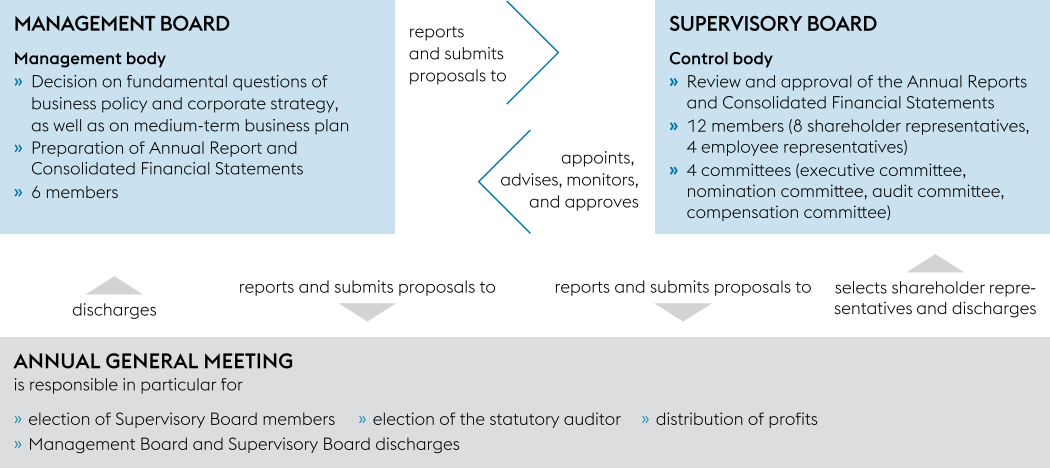
The governance structure of voestalpine AG is based on a dual management model. This model includes the Management Board as a management body and the Supervisory Board as a supervisory body. The Management Board takes over the management and representation of the joint stock company and is responsible for the strategic decisions. The Supervisory Board supervises the management of the Management Board and is responsible for the appointment of members of the Management Board. The Articles of Association authorize the Supervisory Board to appoint committees and to define their rights and responsibilities. In addition to the statutory Audit Committee, the Supervisory Board of voestalpine AG has formed a General Committee, a Compensation Committee, and a Nomination Committee from among its members.
The dual management system ensures a clear separation between the company’s operational management and the independent oversight of its activities.
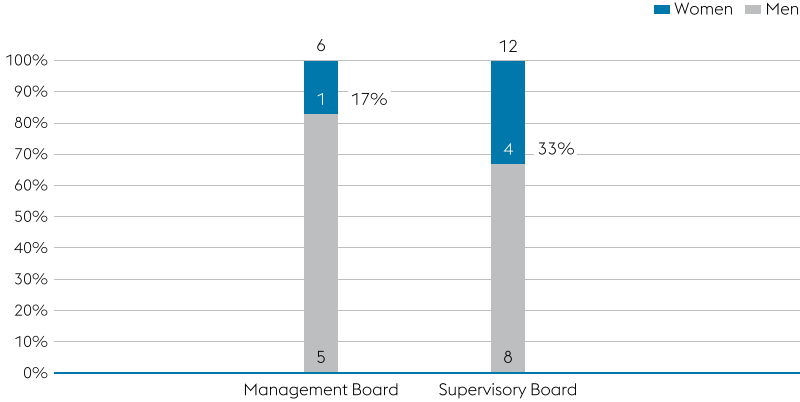
As in the previous year, the Management Board of voestalpine AG consisted of six members as of the reporting date. The percentage of female members was 16.7% while the percentage of male members 83.3%. The ratio of female to male members (gender diversity ratio) is therefore 20% or 1:5. Five Management Board members are Austrian nationals, and one is a German national.
As in the previous year, the Supervisory Board of voestalpine is made up of eight shareholder representatives and four employee representatives. The proportion of women in the Supervisory Board is 33.33%, comprising three shareholder representatives and one employee representative. With the exception of one member who holds Swiss citizenship, all Supervisory Board members are Austrian.
As of the March 31 reporting date
As of the March 31 reporting date
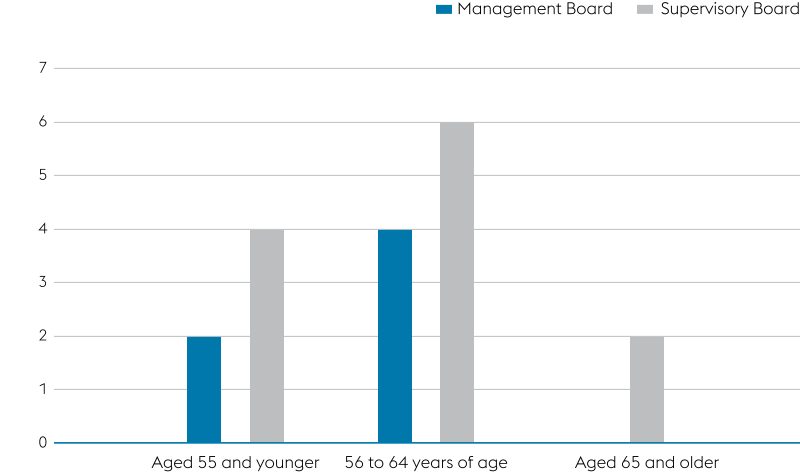
Additional information on the composition of the Management Board can be found in the most recent Consolidated Corporate Governance Report 2025/26 (chapter “Composition of the Management Board”).
Additional information regarding the composition of the Supervisory Board, its committees, as well as the number and key topics of meetings in the 2025/26 business year can also be found in the most recent Consolidated Corporate Governance Report 2025/26 (chapter “Composition of the Supervisory Board”). The Supervisory Board possesses a wide range of expertise, professional experience, and management skills, ensuring effective oversight and guidance of the Management Board. This expertise is particularly important in the context of the Corporate Sustainability Reporting Directive (CSRD). An overview of the specific skills and expertise of the Supervisory Board members can be found in the qualifications matrix in the Consolidated Corporate Governance Report 2025/26, in the chapter “Composition of the Supervisory Board.”
The Management Board and the Supervisory Board are regularly informed and trained on relevant topics related to compliance, auditing, and sustainability during Management Board and Supervisory Board meetings. In addition, they may consult internal and external consultants and experts as required to enhance their knowledge on certain subjects. This ensures that the committees consistently possess up-to-date and well-founded expertise on sustainability.
Both the Management Board and the Supervisory Board bring together diverse competencies and experience to effectively address the material impacts, risks, and opportunities.
GOV‑1 – G1 business conduct
The Code of Corporate Governance provides Austrian stock corporations with a framework for transparent, responsible, and sustainable corporate management and oversight. It is based on the provisions of Austrian stock corporation, stock exchange, and capital market law and is aligned with the OECD Guidelines for Corporate Governance.
The Austrian Code of Corporate Governance was last amended in January 2025. Compliance with the code is voluntary and aims to promote responsible corporate governance focused on sustainable and long-term value creation. Through its voluntary commitment, voestalpine adheres to these principles and promotes a high level of transparency for all stakeholders of the company.
The Management Board and the Supervisory Board of voestalpine AG resolved as early as in 2003 to recognize the Austrian Code of Corporate Governance. Currently, in addition to the mandatory “L Rules,” voestalpine also complies with all “C Rules” and, with the exception of R Rule 40a, all “R Rules” (recommendations) of the Code as amended in January 2025. The Supervisory Board has defined guidelines for its independence in accordance with C Rule 53 of the Austrian Code of Corporate Governance and published them on www.voestalpine.com under Investors/Corporate Governance. All members elected by the Annual General Meeting have made a written declaration of their independence in the course of their appointment (C Rule 53 ÖCGK). Accordingly, all elected members of the Supervisory Board (100%, excluding employee representatives)—seven members at the time of their election and one member from August 2024—have declared themselves independent.
Duties and responsibilities of the members of the Management Board and Supervisory Board in relation to sustainability
The Management Board proactively drives progress on sustainability topics and plays a central role in monitoring, managing, and overseeing the impacts, risks, and opportunities. It is informed about sustainability topics during regular board meetings and is involved in monitoring actions, setting new targets, and addressing emerging challenges.
In close coordination with the administrative, management, and supervisory bodies, voestalpine’s sustainability-related goals were defined in terms of material impacts, risks, and opportunities as part of the development of the Group Strategy 2030+ and the associated sustainability strategy. The progress and achievement of the goals is monitored as part of the annual strategy review process.
Strategic responsibility for sustainability within the Management Board lies with the CEO. The corresponding operational tasks are handled by the sustainability organization, led by the Head of Group Sustainability, and by the Corporate Development department. Further information on the composition and tasks of the Group sustainability organization can be found in sections GOV‑2 and GOV‑5. Regular reports to the Supervisory Board of voestalpine AG enable effective oversight. This oversight also acts as a central control procedure for the management of impacts, risks, and opportunities, and results, for example, in the Group-wide resilience analysis, which assesses the company’s resilience to climate-related risks and opportunities (for more information on the resilience analysis see chapters SBM‑3 E1 and IRO‑1 E1).