
I, R&D innovation, research, and development
Innovation, research, and development
| Disclosure requirement | Name with reference | |
|
SBM-3 |
Material impacts, risks, and opportunities and their interaction with strategy and business model |
|
|
I, R&D-1 |
||
|
I, R&D-2 |
Actions and resources related to innovation, research, and development |
|
|
I, R&D-3 |
||
|
I, R&D-4 |
The following table provides specific information on SBM‑3:
Topic/sub‑topic |
|
|
|
Impact, risk, opportunity (IRO) |
|
Description |
|
Value chain |
|
Time horizon |
|
Affected stakeholders |
|
|
|
|
|
|
|
|
|
|
|
|
|
Innovation, research & development |
|
|
|
Product innovations |
|
Through ongoing research and development, the product portfolio is being expanded to include low-emission steel grades from certified sites, as well as innovative materials and components that take environmental considerations into account |
|
▷▶▷ |
|
|
|
|
|
✚ |
|
Increased recycling efficiency through technological innovation |
|
Introducing innovative technologies into the recycling process can boost efficiency and further increase the recycling rate, especially for old scrap, resulting in cost savings through increased resource efficiency and reduced reliance on purchased materials. This is also essential as it helps with entering new scrap markets and the associated stabilization of the material supply |
|
▶▶▶ |
|
|
|
|
|
|
✚ |
|
Breakthrough technologies |
|
voestalpine invests in research, development, and innovation to establish the technological basis for steel production with net-zero CO2 emissions. These breakthrough technologies include, in particular, processes for hydrogen-based steel production, such as Hy4Smelt, or for carbon capture, utilization and storage (CCUS) |
|
▷▶▷ |
|
|
|
|
|
|
ǃ |
|
Ensuring product quality with increased use of scrap |
|
The increased use of scrap in the course of the transition of primarily coal-based blast furnaces to electric arc furnaces carries the risk of decreasing product quality. This risk is material due to potential quality losses arising from changes in the use of raw materials (scrap, fine ore) and due to high quality requirements in the customer industries |
|
▷▶▶ |
|
|
|
|


|
||||||||||||||||||||||||||||||||||||||||||||||||||||||||


Impact, risk, and opportunity management
I, R&D-1 – Policies related to innovation, research & development
As key elements of the corporate strategy, Research and Development (R&D) and Innovation make a significant contribution to voestalpine’s position as a leader in innovation, technology, and quality. In the business year 2025/26, the R&D and Innovation Strategy 2030+ was developed on the basis of the Group Strategy 2030+, with implementation planned to begin in the 2026/27 business year. The strategy aims to ensure the long-term economic success of the company through innovative processes and sustainable products.
voestalpine’s decentralized R&D and Innovation organization is underpinned by strategic innovation guidelines, a defined innovation process, and the alignment of research projects with the phased implementation of CO2 emission reduction technologies to achieve net-zero emissions by 2050. As research cannot be considered in isolation, no measurable and specific outcome-oriented targets have been set for R&D and innovation at this stage (see chapter I, R&D-3).
Policies related to R&D and innovation are not based on external statements or principles, and there are no available frameworks or standards on which this report is based with the exception of MDR-P from the ESRS standard. The geographical area and scope of the policies encompasses all of the Group companies around the world active in R&D. The strategies are communicated internally through the R&D network, namely at internal events and on the Group-wide intranet. The strategies are communicated to external stakeholders, such as customers or applicants, for example at presentations or on company websites.
Organization of innovation, research, and development at the voestalpine Group
R&D and innovation at the voestalpine Group is organized in a decentralized manner in order to ensure close links are maintained with the respective companies, their production, and quality control as well as with the market and customers. The global network with around 70 locations involved in R&D is centrally controlled from Linz by the Research Board and Research Coordination.
The Research Board, which is composed of the members of the Management Board of voestalpine, the divisional technical directors and the Head of Group Development, meets twice a year. It coordinates the Group and divisional innovation roadmaps, thereby setting the research priorities. The research activities within the divisions are led by an R&D coordinator, while digitalization agendas that involve R&D are managed by the divisional digitalization coordinators. The respective steering committees meet quarterly. The Research Committee is primarily composed of the research managers at companies and business units that engage in R&D, and provides a format for the sharing of information between the individual divisions as well as strengthening synergies across divisional boundaries. The Research Committee and Research and Digitalization Coordination are chaired by the Group Head of Research.
Strategic R&D management, overseen by the Group Head of Research, plays an overarching role within the organization. One of its core tasks is to represent the Group in matters concerning R&D, research policy, and public relations. Other activities include the coordination of committees and steering groups, the preparation of the R&D strategy, and active patent, literature, and funding management. The Group’s internal research organization is complemented by cooperation with external scientific partners.
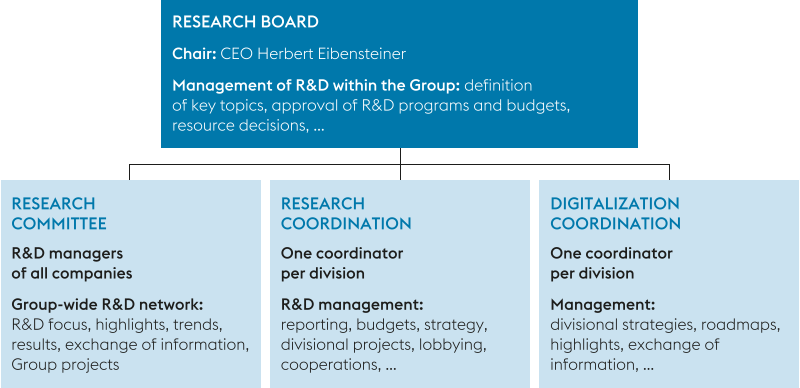
The decentralized organization of research activities within the voestalpine Group makes a significant contribution to strengthening the efficiency and effectiveness of the corresponding product and process innovations. Each research site has specific core competencies, which facilitates the development of a diverse range of products. In addition, the pooling of expert knowledge at select locations promotes the implementation of process innovations geared towards a sustainable society.
Strategic innovation guidelines
voestalpine’s R&D and Innovation strategy is directly derived from the Group strategy. The strategic innovation principles underline the importance of R&D within the Group and its contribution to the sustainable and successful development of voestalpine. They were completely revised as part of the strategy process in the business year 2025/26:
We align our R&D-activities strategically from: R&D activities are clearly aligned with the strategic direction of the voestalpine Group, with a focus on value creation and competitiveness.
We rely on focused R&D and transparent control: R&D projects of high strategic importance are prioritized and allocated the appropriate resources. Select priority topics are the focus in this regard.
We create synergies through internal and external cooperation: We rely on interdisciplinary teams, knowledge sharing and knowledge transfers, and strengthen competencies in Group-wide clusters of experts. Together with our global network of scientific partners, we work on common issues over the long term.
We develop innovations for and in partnership with our customers: We work in close collaboration with our customers and their R&D departments to develop products, systems, and business models from the initial concept to market launch.
Our R&D employees are the most important factor in our success: The human factor is paramount, and we prioritize training, qualifications and promoting young talent to secure long-term expertise.
We are committed to continuous improvement: Our developments are aimed at improving quality and optimizing costs.
We are breaking new ground and embracing innovation: We are curious and open to new trends and technologies, driven by creative freedom and a willingness to take risks.
R&D is the driving force behind the green transformation: We actively accept the challenges and opportunities posed by the green transformation, and develop processes to integrate new production routes. As a core aspect of our innovations, we take sustainability into account both in the manufacturing process as well as in the downstream processing and use phases.
Our strategic innovation guidelines are specifically geared towards the IROs for product innovations. When formulating the guidelines, the interests of various stakeholders, including customers, employees, and applicants, as well as the Management and Supervisory Board, were taken into account through measures such as dialogues, cooperation, and events.
Prioritized innovation roadmaps
All R&D activities are aligned with the voestalpine Group strategy (see strategic innovation guidelines), which is geared toward current and relevant megatrends. These activities are assigned to the research priorities of the individual divisions and summarized in the prioritized innovation roadmaps. Each key topic is broken down into more detail in the corresponding roadmaps of the divisions, business units, and companies, and eventually at individual project level. The innovation roadmaps depict development programs and projects with a time horizon of 10 to 15 years.
Preparation of the prioritized innovation roadmaps falls under the responsibility of the R&D coordinator of each division. Once complete, the roadmaps are coordinated with the members of the Management Board in charge of the divisions on the corresponding decision-making boards. This is followed by annual approval by the Management Board within the framework of the Research Board. The respective prioritized innovation roadmaps—available for all companies that engage in R&D in the individual divisions—aim to define medium and long-term innovation priorities in terms of product and process development, and to allocate the necessary resources. This allows voestalpine to help shape new market trends and establish successful innovations (see IROs for product innovations). The roadmaps take into account the needs of customers and markets along with any new technological advancements or legal requirements and standards.
R&D strategy for modular implementation of new technologies to achieve decarbonization targets
In order to achieve the decarbonization targets, the R&D and Innovation strategy pursues a three-pronged approach to prepare for and accompany the Group’s decarbonization strategy:
- In the first stage, the existing blast furnace processes are optimized to minimize CO2 emissions and to ensure the efficient use of by-products.
- Progress is made on the electrification of processes in the first expansion step. Intensive research activities are required to facilitate the commissioning and successful operation of the electric arc furnaces at the sites in Linz and Donawitz. These activities include test melts, the development of alloy concepts as well as simulations and modeling. Research is focused on upholding our ability to continue producing the highest quality steel grades even after the process route has been changed in order to counteract the risk of decreasing product quality due to a higher use of scrap material in the EAF route. Due to increasing demand for scrap metal, research is needed to make the most efficient use of available resources and to tap into new sources, such as post-consumer scrap, for example through closed loops with customers.
- In order to achieve the net-zero emissions target by 2050, new technologies must be developed and brought to market, in addition to electric arc furnaces. These breakthrough technologies include SuSteel (Sustainable Steelmaking), which is already delivering initial results on a pilot scale, and the globally unique Hy4Smelt demonstration plant, which is being built at the Linz site as an extension of the HYFOR pilot plant. In addition to these carbon direct avoidance technologies, which prevent the generation of CO2 already in the process, processes for the capture, storage and utilization (CCUS) of unavoidable CO2 emissions are also being developed. The further development and especially the implementation of these methods are research and resource intensive, requiring comprehensive applied basic research.
This research strategy addresses the IROs for the topics of breakthrough technologies, increasing recycling efficiency through technological innovation, and ensuring product quality with the increased use of scrap. It takes into account the interests of management, legislators, customers, and residents near the location and in communities neighboring the steel-producing companies, whose emissions are gradually reduced as a result.
IROs addressed |
|
Policy |
|
Scope of the policy |
|
Responsibility and monitoring |
|
Other comments |
|
|
|
|
|
|
|
|
|
Product innovations |
|
Strategic innovation guidelines |
|
Own operations |
|
Head of Group-wide Research & Development and Innovation |
|
|
|
Prioritized innovation roadmaps |
|
Own operations to a partial extent |
|
R&D coordinator of the divisions |
|
|
|
Breakthrough technologies |
|
R&D for modular implementation of new technologies to achieve decarbonization targets |
|
Own operations |
|
Project managers of R&D sub-projects |
|
|
I, R&D-2 – Actions and resources related to innovation, research & development
Research projects derived from the innovation roadmaps constitute the actions taken in the field of innovation, research, and development to address the related impacts, risks, and opportunities (IROs). For the business year 2025/26, six actions or packages of actions (five actions in Business Year 2024/25) have been identified that will contribute in particular to achieving the projects and objectives of the strategies related to R&D and innovation. Packages of actions refer to a set of several individual R&D projects that contribute to the fulfillment of an overarching priority topic.
Due to their high strategic relevance, two of these actions are also being managed as Group projects. In addition to individual projects, which are usually handled by a team of researchers who are assigned to a company or business unit in organizational terms, division-wide competencies are pooled in Group projects. Group projects address strategically important issues and are associated with high project costs and a higher project risk. This targeted cooperation accelerates implementation, thereby increasing efficiency. The following Group-wide R&D projects were undertaken in the business year 2025/26:
- Sustainable products (project duration December 1, 2022 to November 30, 2025)
- Simulation of complex (supply chain) networks (project duration April 1, 2024 to March 31, 2028)
In line with the voestalpine standard on monitoring the progress of Group research projects, the implementation of actions is monitored as follows:
The definition of targets such as acquiring expertise, future income, or sales
Project controlling by a steering committee (quarterly)
Status report to the Management Board within the framework of the Research Board (annual)
A defined monitoring process applies to all projects that are not managed within the scope of Group projects: Monitoring of the implementation of the described actions is carried out within the scope of progress reporting for the entire R&D project portfolio. Milestones are defined and their achievement is monitored within the framework of project management and project controlling. Content, scheduling and cost aspects are taken into account in the process. If milestones are not reached, adjustments are made or the projects are prematurely stopped.
The actions and packages of actions are explained in detail below and are discussed with regard to impacts, risks, and opportunities. The stated R&D expenses are solely OpEx costs and the implementation of the projects is not subject to any preconditions. An exception is the Hy4Smelt initiative, to which CapEx expenses are also allocated but by definition are not part of (gross) R&D expenditure. A total of EUR 32.06 million (2024/25: EUR 19.36 million, OpEx only) was spent on the R&D projects in the past business year as a result of the actions listed above, of which EUR 26.13 million OpEx costs and EUR 5.93 million CapEx costs. OpEx costs represented 11.79% of total gross R&D expenditure (2024/25: 8.85%, based on the corresponding gross R&D expenditure). Similar levels of expenditure are also planned for the business year 2026/27 to ensure the ongoing implementation of planned projects.
R&D for sustainable products and Group project “Sustainable Products”
The Group project “Sustainable Products,” which was launched in December 2022 and ended as scheduled in November 2025, contains 22 sub-projects focused on energy and mobility, products for agriculture and the food industry, and aspects to optimize products in the use phase. A total of 25 Group companies from all divisions were involved in the implementation of this action. Overall project management and coordination fell under the remit of the Metal Forming Division, which is also the division most involved in the sub-projects. By pooling expertise, sustainable products can be brought to market in a relatively short period of time and generate sales within a few years. For example, as part of a sub-project of the High Performance Metals Division, a complete process chain for high-quality tool repair was developed. In the Metal Forming Division, a pilot sub-project developed mounting structures for agrivoltaics, enabling the dual use of land for electricity generation and agriculture. In the final year of the project, a particular focus was placed on the orderly completion of the corresponding individual projects and finalization of the project documentation.
R&D expenditure for all sub-projects up to the end of the project came to EUR 9.58 million in the business year 2025/26 (2024/25: EUR 8.40 million). EUR 29.02 million was spent over the entire project period. This action focuses on the IROs of product innovations by integrating environmental requirements into the development of new products through R&D activities. This will strengthen both the competitiveness and the financial performance of voestalpine.
R&D for greentec steel – experimental melting, dynamic alloying, and active interventions in production processes
The production of steel grades of consistent quality even after the transition from the blast furnace to the electric arc furnace route poses a major challenge, especially for the high-quality automotive and wire rod segments. The increasing proportion of scrap in the input material leads to an increase in the level of accompanying elements, which has direct impacts on mechanical properties such as the strength, ductility, and hardenability of the end product. R&D therefore focuses strongly on determining the relationship between the steel grade, the mix of input materials, and the resulting product characteristics.
The package of R&D actions for greentec steel, primarily processed by the Metal Engineering Division and the Steel Division, comprises the following focal points:
-
Experimental melts and experimental programs (Metal Engineering and Steel Division)
The influence of the level of accompanying elements on the physical and chemical properties can be investigated through the targeted production of melts with a defined composition. These studies provide the basis for further experimental activities. -
Dynamic alloying (Metal Engineering and Steel Division)
Since the exact composition of the scrap is known only after melting in the electric arc furnace, metallurgical counter-measures are necessary during the process. Dynamic alloying allows the alloy quantity to be adjusted so that the final properties of the product remain within specified limits. -
Forecast-driven process adjustments (Steel Division)
Not only the material composition, but also the processing parameters have a significant influence on the final properties of the product. By purposefully adapting the process parameters in the last property-determining step, namely the annealing furnaces, material properties can be adapted to the specified limits.
Since 2021, the transition of the production routes on electric arc furnaces in Linz and Donawitz has been accompanied by intensive research. By the time the first electric arc furnaces are commissioned in 2027, the first intensive phase of R&D is scheduled to be completed. However, research activities to maintain product properties will continue in the years that follow. In the business year 2025/26, related research activities continued in order to make a significant contribution to the successful transition of the process routes.
The package of actions mitigates the risk of ensuring product quality in the case of higher levels of scrap due to the transition from the blast furnace route to the electric arc furnace route. The described R&D activities can minimize this risk, which is based on physical/chemical principles. The ability to react rapidly to the composition of input materials, in particular the proportion of accompanying elements in scrap, also improves recycling efficiency through technological innovation. A total of EUR 14.14 million (2024/25: EUR 9.26 million) was spent on the individual R&D projects for this key research focus in the past business year.
Simulation of complex networks and post-consumer scrap
Scrap is already playing an essential role at voestalpine’s production sites. Due to the limited availability of high-quality steel scrap on the world market, research activities are necessary both to increase the efficiency of recycling processes, especially for old scrap, and to venture into new scrap markets. In particular, the conversion of process routes from blast furnaces to electric arc furnaces is accompanied by a sharp increase in scrap demand. The objectives of the “Simulation of complex networks” action are to understand and visualize the supply chains relevant to the voestalpine Group, to simulate and optimize the flow of scrap, as well as to simulate worst-case scenarios and develop remedies. The topic has been implemented as part of a Group project since April 2024 and is planned to run for four years. In the past business year, the planned milestones were achieved, with a particular focus on gaining an understanding of multi-sectoral and multi-regional dependencies as well as on the advanced modeling of the rail system. In the past business year, EUR 0.33 million was spent (2024/25: EUR 0.22 million).
In other individual projects, the voestalpine experts are intensively researching the treatment and use of scrap, otherwise known as post-consumer scrap. Compared to new scrap, which is produced as waste during punching, for example, the use of post-consumer scrap, which is often mixed with other materials, can present a number of challenges. Composite materials and other non-metallic components need to be separated in a complex process before further processing. The KIRAMET project (artificial intelligence-based recycling of metal composite waste), for example, involves working with partners from academia and industry on AI-based solutions for processing these material flows. In the project consortium, voestalpine is responsible for classifying reprocessed scrap with innovative sensor- and model-based solutions, and investigating the impact of this on the production of high-quality steel products. During the project period from July 1, 2023 to December 31, 2026, the aim is not only to increase the added value of secondary raw materials; networking between industrial companies will also enable holistic management of the recycling chain.
The projects listed in this package focus on the IROs related to increasing recycling efficiency through technological innovation. By systematically analyzing scrap streams and gaining an understanding of the relevant supply chains, active steps can be taken to ensure a stable supply of materials. In addition, the targeted processing of old scrap can open up additional material sources and significantly increase resource efficiency.
Application of SuSteel technology and operation of the SuSteel pilot plant in Donawitz
A trial project is currently being undertaken in the SuSteel (sustainable steel) test plant at the voestalpine Stahl Donawitz GmbH site: the production of crude steel using hydrogen plasma in a single process step. In this CO2-free method, in which only steam is produced as a by-product, the intermediate stage of pig iron can be completely bypassed. In addition to voestalpine Stahl GmbH and voestalpine Stahl Donawitz GmbH, two long-term academic cooperation partners, namely K1-MET and the University of Leoben, are also involved in the implementation of this project.
In the past business year, R&D expenses of EUR 0.86 million (2024/25: EUR 0.89 million) were incurred for individual projects related to SuSteel technology. The SuSteel test plant, which has been successfully operating since 2021, demonstrates that the single-stage reduction of iron ores using hydrogen is an important alternative to fossil-based reducing agents such as coke, coal, or natural gas. The experimental findings on this breakthrough technology will also be of great importance, especially in the third stage of the successively implemented decarbonization plan to achieve net-zero emissions by 2050. The main research priorities in the past business year were, in particular, securing the supply of hydrogen and improving gas recovery. The package of actions is based entirely on the IROs for the application of the breakthrough technologies and makes a key contribution to building the necessary expertise for steel production with net-zero emissions by further developing hydrogen-based processes.
Hy4Smelt demonstration plant – combining HYFOR technology with the smelter process
Since fall 2025, construction of the world’s first demonstration plant, Hy4Smelt has been underway at the voestalpine site in Linz. The plant will be able to combine hydrogen-based direct reduction for ultrafine iron ores using HYFOR technology with an electric melting process (smelter). This project is being undertaken on the basis of the results from the HYFOR pilot plant, which is being operated at the voestalpine Stahl Donawitz GmbH site in partnership with partners from the worlds of industry and academia. HYFOR technology (hydrogen-based fine-ore reduction) enables the direct reduction of ultrafine iron ores in a fluidized bed using 100% green hydrogen without prior sintering or pelleting. The direct reduced iron (DRI) is melted in the smelter using electricity from renewable sources under a protective atmosphere. This results in the end product of granulated pig iron (GPI), which can be used and further processed in electric arc furnaces and LD converters. The green hydrogen required for the reduction step is generated directly at the Linz site through hydrogen electrolysis in the H2FUTURE pilot plant.
The groundbreaking ceremony for this demonstration plant took place on September 2025 and commissioning is planned for the end of the calendar year 2027. The research project, which runs until 2030, is being implemented by voestalpine Stahl GmbH and voestalpine Stahl Donawitz GmbH, together with the international plant manufacturer Primetals Technologies, and Rio Tinto, one of the world’s largest mining groups. The K1-MET metallurgical competence center is the lead scientific partner on the project.
The total planned expenditure for the project is approximately EUR 170 million, of which voestalpine’s share is EUR 41.8 million. Hy4Smelt is co-financed by Austrian (aws/Twin Transition and KPC/Transformation der Industrie) and European (RFCS/Clean Steel Partnership and Clean Hydrogen Partnership/Hydrogen Valleys) funding bodies. The R&D expenditure (OpEx) for the preparatory projects in the HYFOR package amounted to EUR 0.80 million in the business year 2025/26 (2024/25: EUR 0.59 million). With the start of implementation in the reporting year, the CapEx expenses in the business year 2025/26 amounted to EUR 5.93 million. The Hy4Smelt measure relates entirely to the IROs related to breakthrough technologies. The research into and construction of the demonstration plant marks an important intermediate step on the path to scaling up hydrogen-based technologies for steel production and establishing the corresponding technological basis.
Carbon capture and utilization (CCU) – cross-sectoral demonstration with the ZEUS project
Hydrogen-based steel production methods, such as SuSteel or Hy4Smelt, are considered carbon direct avoidance technologies through which the generation of CO2 emissions is avoided by the use of hydrogen as a reducing agent. However, unavoidable residual emissions are also generated as a result of the overall process; these can be actively converted into usable products through carbon capture and utilization (CCU). In the cross-sectoral flagship project ZEUS (Zero Emissions through Sector Coupling), voestalpine Stahl GmbH is demonstrating a climate-neutral process chain with partners from academia and industry. The corresponding steps include the production and processing of green hydrogen under fluctuating process conditions, the capture of CO2 from industrial waste gases and its subsequent conversion into valuable and storable products. An amine scrubber is used for the capture, with various solvents and membrane concepts being investigated. The conversion takes place, for example, in the methanation plant in which CO2 is converted into synthetic methane (CH4) using hydrogen in a catalyst. The methane is then fed back into the circuit. In a pilot plant that went into operation at the start of the 2026 calendar year, the electrochemical conversion of CO2 into synthesis gas that can then be used as a reducing agent is being tested.
In addition to the value chain within voestalpine’s own operations, the project is exploring the integration of the energy, hydrogen, steel, and cement industries into a continuous process chain. The project was launched at the beginning of October 2023 and runs for four years. The corresponding (gross) R&D expenditure came to EUR 0.42 million in the business year 2025/26 (2024/25: EUR 0.15 million). ZEUS is funded by the Climate and Energy Fund and is being carried out as part of the Energy Research Program 2022. The measure relates entirely to IROs for breakthrough technologies and contributes to achieving the long-term target of net-zero emissions by 2050.
IROs addressed |
|
Action |
|
Time horizon |
|
Scope of the action |
|
Significant expenditure (if relevant)/other comments |
|
|
|
|
|
|
|
|
|
Product innovations |
|
Package of measures: R&D for sustainable products and Group project “Sustainable Products” |
|
December 2022 – November 2025 |
|
Own operations to a partial extent |
|
EUR 9.58 million OpEx (Group project) |
Ensuring product quality with increased use of scrap |
|
Package of R&D measures for greentec steel: experimental melting, dynamic alloying, and active interventions in the production process |
|
2021 – 2027 (Phase 1) |
|
Own operations to a partial extent |
|
EUR 14.14 million OpEx |
Increased recycling efficiency through technological innovation |
|
R&D Group project “Simulation of complex networks” and post-consumer scrap |
|
April 2024 – March 2028 |
|
Own operations to a partial extent |
|
EUR 0.33 million OpEx (Group project) |
Breakthrough technologies |
|
Package of measures: Application of SuSteel technology and operation of the SuSteel pilot plant in Donawitz |
|
Ongoing; application particularly during Phase 3 of the Climate Transition Plan |
|
Own operations to a partial extent |
|
EUR 0.86 million OpEx |
|
Package of measures: Hy4Smelt – combining HYFOR technology with the smelter process |
|
Ongoing; application particularly during Phase 3 of the Climate Transition Plan |
|
Own operations to a partial extent |
|
EUR 0.80 million OpEx |
|
|
Carbon capture and utilization (CCU) – cross-sectoral demonstration with the ZEUS project |
|
Ongoing; application particularly during Phase 3 of the Climate Transition Plan |
|
Own operations to a partial extent |
|
EUR 0.42 million OpEx |
Metrics and targets
I, R&D-3 – Targets related to innovation, research R&D development
In light of its overarching role within the voestalpine Group, research, development and innovation forms a link between Group-wide sustainability goals and process and product innovations. The findings from numerous R&D related actions not only affect quantifiable targets, but must also be considered in the context of manufacturing processes. Process innovations in relation to the green transformation contribute significantly to reducing CO2 emissions; but the savings cannot be attributed exclusively to R&D and innovation. Success in setting up and further developing the circular economy at all voestalpine locations largely depends on progress in development. As it is not possible to view this as an isolated factor, no R&D-specific measurable and outcome-oriented targets have currently been defined.
The effectiveness of the R&D projects set forth in the innovation roadmaps, which address material impacts, risks, and opportunities for voestalpine, is subject to a Group-wide guideline for assessing benefits. This ensures that all project benefits undergo consistent, transparent, and accountable monetary and non-monetary assessment, verification, and tracking in relation to R&D and innovation. As part of assessing benefits, a distinction is made between pre-project (ex-ante) and post-project (ex-post) evaluation. For projects that cannot be assessed in monetary terms, ex post checks are carried out to determine whether the planned intangible benefits have been achieved and whether the resulting projects have resulted in product or process developments. The knowledge gained in the course of this process is used to plan and manage future R&D projects in order to promote continuous improvement and strengthen the company’s innovative power.
I, R&D-4 – Metrics related to innovation, research, and development
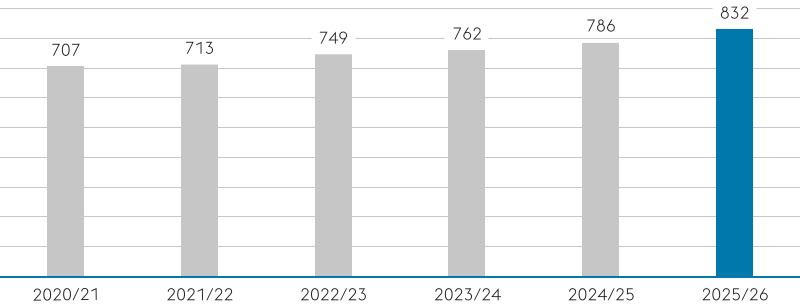
Researchers play a central role in the success of innovation, research activities, and development. In the business year 2025/26, 832 people (2024/25: 786 people) at the various voestalpine sites conducted research on innovative products and improved processes on an ongoing basis. In doing so, they made a significant contribution to achieving the company’s environmental objectives. The number of employees in R&D corresponds to the total number of employees (headcount) who are directly assigned to the R&D departments of the individual Group companies. Employees who are involved in R&D projects but assigned to other areas are not included in this figure. In recent business years, the number of employees in R&D and innovation has steadily increased.
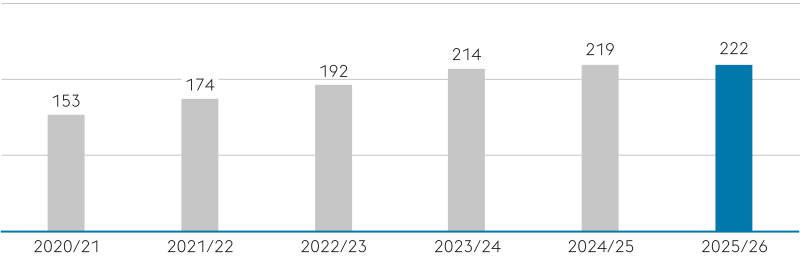
The high number of employees in R&D is accompanied by high R&D expenditure (gross). In the business year 2025/26, EUR 221.61 million (2024/25: EUR 218.89 million) was spent on research and development activities, reinforcing the key role of these activities in the business model of the voestalpine Group. A significant proportion of R&D expenditure is invested in projects that increase the sustainability of voestalpine processes and products in the long term. A slight increase in the R&D budget is planned in the 2026/27 business year. The (gross) R&D expenses are also included in Note B.3. Significant accounting policies in the notes to the Consolidated Financial Statements.
Total R&D expenses (gross) are calculated as the sum of the R&D expenses (gross) of all companies involved in R&D. R&D expenditure (gross) includes all expenses (directly attributable costs excluding VAT) for all R&D activities in the business year, which can be undertaken as part of the R&D program, regardless of whether they are carried out in the dedicated R&D departments or in other areas. These include personnel costs (salaries) and direct expenses for R&D (such as material costs, travel costs, use of infrastructure, and third party costs). Depreciation on fixed assets and patent application and maintenance costs are not included.
No assumptions or estimates are made for the calculation of either parameter, there are no limitations and, due to the low complexity of the computation, no validation is performed by external bodies. The two metrics are recorded in the OneStream consolidation tool. The responsibility for data entry lies with the respective consolidation tool officers in the Group companies. The accuracy of the data is verified by internal bodies (R&D managers and controlling) as part of a multi-stage review and approval process, and no external bodies are involved in the reporting.
In each case as of the March 31 reporting date
In millions of euros
ESRS disclosure requirement |
|
Paragraph |
|
Datapoint/metric |
|
Basis for the preparation and description of the assumptions and methodology |
|
Information on sources of a high level of measurement uncertainty and information on measurement |
|
|
|
|
|
|
|
|
|
I,R&D (entity-specific topic) |
|
– |
|
R&D expense (gross) |
|
Sum of R&D expenses (gross) for all companies involved in R&D. R&D expenditure (gross) includes all expenses (directly attributable costs excluding VAT) for all R&D activities in the business year, which can be undertaken as part of the R&D program, regardless of whether they are carried out in the dedicated R&D departments or in other areas |
|
Limited—data represents the individual companies |
I,R&D (entity-specific topic) |
|
– |
|
Number of employees in R&D |
|
The number of employees in R&D corresponds to the total number of employees (headcount) who are directly assigned to the R&D departments of the individual Group companies |
|
Limited—data represents the individual companies |