
ESRS E5 Resource use and circular economy
ESRS E5 – Resource use and circular economy
| Disclosure requirement | Name with reference | |
|
SBM-3 |
Material impacts, risks, and opportunities and their interaction with strategy and business model |
|
|
E5-1 |
||
|
E5-2 |
Actions and resources related to resource use and circular economy |
|
|
E5-3 |
||
|
E5-4 |
||
|
E5-5 |
Steel offers the ideal prerequisites for the circular economy due to its full recyclability, its durability, and its reparability. voestalpine is committed to resource efficiency by reintroducing scrap and other metallic residues back into the production process. By 2030, the use of secondary raw materials is to be further intensified by increasing the use of scrap in crude steel production by 50%.
By-products such as slag, dust, and sludge are recycled within the company or transferred to other industries where technically feasible and legally permissible. This reduces the company’s reliance on primary raw materials.
In addition, voestalpine helps its customers increase their use of secondary raw materials through closed material cycles and recycling policies. The aim is to keep raw materials in the economic cycle for as long as possible and to minimize waste.
The following table provides specific information on SBM‑3:
Topic/sub‑topic |
|
|
|
Impact, risk, opportunity (IRO) |
|
Description |
|
Value chain |
|
Time horizon |
|
Affected stakeholders |
|
|
|
|
|
|
|
|
|
|
|
|
|
Resource inflows, including resource use |
|
|
|
Sourcing and use of primary resources |
|
The extraction and refining of primary raw materials, in particular iron ore, coking coal and metallic alloying elements, results in significant material environmental impacts along the whole value chain. Collectively, raw material extraction, transport, processing and use have a decisive influence on the environmental profile of the metal and steel industry |
|
▶▷▷ |
|
|
|
|
Resource outflows related to products and services; and waste |
|
|
|
Business models for recycling |
|
voestalpine helps its customers increase their recycling rate by concluding and implementing circular economy agreements (e.g., recycling agreements) with a focus on recycling scrap iron and steel scrap. The increased use of secondary materials can significantly reduce the CO2 intensity per ton of steel. The establishment of closed-loop material cycles and growing customer demands for resource efficiency also contribute to this materiality |
|
▶▷▶ |
|
|
|
|


|
||||||||||||||||||||||||||||||||||||||||||||||||||||||||

Impact, risk, and opportunity management
E5‑1 – Policies related to resource use and circular economy
Sustainability strategy – Circular economy
In business year 2025/26, voestalpine refined and further developed the circular economy strategic sphere of action as part of its sustainability strategy. This took place on the basis of the existing circular economy concept, which takes into account the external requirements of customers, markets, regulatory frameworks, and society as well as the challenges posed by a volatile commodity and energy market. It also sets forth internal priorities to ensure the economic and sustainable use of resources.
Within the framework of the circular economy concept, several strategic priorities have been identified. These were addressed as part of the review of the sustainability strategy under the circular economy and resource conservation sphere of action, refined, and further specified:
- Improving the life cycle assessment through sustainable process design across the entire value chain
- Ensuring the supply of raw materials in the long term and reducing dependence on individual countries
- Increasing resource efficiency by optimizing material use and minimizing waste
- Supporting the achievement of voestalpine’s sustainability targets and increasing security of supply for customers
- Exploiting economic potential and new business opportunities in relation to the circular economy
Strategic initiatives and actions have been defined, for example, relating to circularity, secondary raw materials, zero waste, and material and energy use, which can facilitate the development of targets.
As an essential component of the Group-wide circular economy strategic sphere of action, voestalpine has already implemented activities for the recycling of material flows and has developed a waste management concept. These initiatives will form the basis for the future strategic orientation and advancement of the Group’s circular economy. As part of the sustainability strategy, the circular economy strategic sphere of action is reviewed regularly as part of the strategy process.
At voestalpine, the circular economy is based on a model with 10 circular economy principles (10R). The circular economy is considered at different levels, covering both processes and products at different stages of the value chain and processing depths, as well as their business models.
The focus is on recovering value components and energy content for use in voestalpine processes and products and expanding cycles to prevent and minimize waste.
The main focus and core aspects of the circular economy at voestalpine are circularity, secondary raw materials, zero waste and complementary circular business models—each at the process and product level.
One important aspect in terms of secondary raw materials is voestalpine’s approach to recycling, which aims to return internal and external scrap (pre-consumer and post-consumer) to production. The recycling initiatives cover the whole value chain—from the sourcing of raw materials to the return of recycled materials to production. voestalpine works in close partnership with its global suppliers and customers.
A particular challenge posed by recycling post-consumer scrap lies in maintaining the quality of the metal in the recycling process. This requires careful collection, sorting, and processing to ensure the scrap can be reused as a high-quality raw material.
The further expansion of scrap circuit loops and the increasing use of internal and external scrap in steel production is expected to improve the use of secondary resources. Use of scrap in crude steel production is also to be increased by 50% by 2030. In addition, extending the product service life through closed product and service cycles and reprocessing of tools and installations helps to reduce primary raw material requirements.
voestalpine works closely with its customers to close material loops. The aim is to increase their recycling rates and to increase the share of recycling and the use of secondary raw materials in general.
In terms of by-products from metallurgical processes, such as blast furnace slag (metallurgical slag), the policy envisages processing and use as secondary raw materials in the company’s own installations or other industrial sectors.
Another important aspect of the circular economy strategic field of action is voestalpine’s zero-waste approach, which aims to minimize or prevent waste as much as possible. In concrete terms, the policy calls for:
- A reduction in waste and landfill volumes, in particular more internal recycling of recyclables
- A reduction in the use of primary materials by introducing more secondary raw materials and recycled materials into the production cycle
- Ensuring the proper treatment of waste through binding agreements with external partners in line with the state-of-the-art technology
- Ongoing electronic monitoring and annual accounting for waste streams to ensure transparency and legal compliance
Environmental policy
The Group’s Environmental Policy is an overarching framework that defines principles and guidelines for various aspects, including the circular economy. This includes circular economies within the framework of voestalpine’s sustainability strategy and environmental management systems. The latter help to clarify and put the principles of the Environmental Policy into practice at an operational level.
Business models for recycling
The voestalpine Group strives to establish and further expand its business models to facilitate recycling. The High Performance Metals Division (HPM), for example, has developed the divisional InSPire concept that covers all aspects of sustainability. As part of this concept, customers are able to participate in sustainable initiatives, while suppliers and partners are motivated to help shape transformation processes.
In terms of the circular economy, HPM focuses on material and scrap cycles, alternative sources of raw materials, recycling by-products, and zero waste.
Procurement policy – Sustainable procurement
Raw materials are sustainably procured on the basis of the Group’s Procurement Policy, which ensures that materials, including raw materials, are obtained in an environmentally friendly, ethical, and socially responsible manner.
In concrete terms, this involves:
- Supplier assessments and on-site audits to ensure compliance with sustainability criteria with regard to the environment (e.g., waste and recycling, water consumption and wastewater, emissions, biodiversity), human rights (e.g., discrimination, child and forced labor, health and protection), working conditions (e.g., working hours, occupational health and safety, fair pay), and governance (compliance and anti-corruption)
- A revised Code of Conduct for Business Partners that contains specific requirements for sustainable procurement For more detailed information, please consult G1‑1
- Ongoing raising of awareness among global business partners with regard to sustainability targets and requirements for transparency in the supply chain
More information on the Procurement Policy can be found in chapter S2‑1.
Innovation, research, and development
In order to optimize the use of resources, voestalpine continuously pursues product and process innovations to set new benchmarks in resource efficiency. Policies and actions related to research, development, and innovation are described in the chapters I, R&D-1 and I, R&D-2.
IROs addressed |
|
Policy |
|
Scope of the policy |
|
Responsibility and monitoring |
|
Other comments |
|
|
|
|
|
|
|
|
|
All IROs for E5 |
|
Sustainability strategy – Circular Economy |
|
Own operations |
|
Management boards of the divisions |
|
|
All IROs for E5 |
|
Environmental Policy |
|
Own operations |
|
Management boards of the companies |
|
|
All IROs for E5 |
|
Business models for recycling |
|
Own operations |
|
Management boards of the divisions |
|
|
Sourcing and use of primary resources |
|
Procurement Policy – Sustainable Procurement |
|
Own operations |
|
Procurement board |
|
|
E5‑2 – Actions and resources related to resource use and circular economy
voestalpine pursues numerous measures to promote its internal circular economy and the external recovery of residues and waste—both from its own production and processing facilities and plants as well as from the downstream value chain. For one, process management in the integrated steel mills is subject to continual improvement. For another, internally and externally generated material flows as well as residual products and waste such as scrap and plastic are re(used) in the production plants.
Priorities for action
In its circular economy and resource conservation strategic field of action—part of its sustainability strategy—voestalpine has modeled its circular economy approach on the ten principles of circular economy (10R). These are implemented throughout the Group with three main areas of focus—narrowing the loop, slowing the loop, and closing the loop.
Loops are narrowed by minimizing the use of resources, increasing energy and material efficiency, and avoiding waste.
By contrast, loops are closed by treating and recycling raw materials and other materials in order to reduce the use of primary raw materials.
The following are examples of activities already being implemented by voestalpine:
- Increasing the use of scrap metal and ensuring economic supply by expanding closed loops (gradual increase in the volume of scrap from external customers in preparation for the first phase of the transformation) with European automotive OEMs, suppliers, and railway operators for high-quality scrap metal and with tool manufacturers for higher-alloy steels
- Optimizing the use of generated waste, as well as the treatment and recycling of associated streams such as scale, slag, sludge, and other metallurgical by-products
- Securing the supply of raw materials by developing alternative secondary raw material sources, including the recovery of valuable materials from production processes (e.g., sludge and dust fractions)
- Increasing the share of secondary materials in products
- External marketing of secondary raw materials, in particular slag, in order to make the best possible use of industrial secondary raw materials
- Reducing waste treatment and disposal, e.g., landfill volumes, through recycling and reuse in production, and processing processes
- Recovering energy using waste heat from production processes, both for internal demand and for supplying to district heating
- Efficiently using process gases as energy carriers in the individual process stages, thereby reducing the need for primary energy
Metal recycling activities contribute to reducing the use of primary resources.
The activities and measures for the scrap circular economy support target achievement pursuant to chapter E5‑3 and are mainly undertaken in the Steel Division and Metal Engineering Division as part of the transformation of production processes for decarbonization efforts, and in the Metal Forming Division. Production in the High Performance Metals Division is already largely scrap-based. Projects are in place across all divisions to promote circular economy, preventing waste, and increasing energy efficiency. The actions therefore extend across the entire voestalpine Group.
Applying circular economy principles to material and energy flows at voestalpine requires broadening the perspective beyond the Group’s own products and processes and integrating other value chains, for example for secondary raw materials, by-products, waste, and energy. voestalpine engages with its stakeholders on the circular economy at various levels. This includes, for example, direct dialog along the value chain with customers, suppliers, investors, and authorities (local, national, international) to support the implementation of activities and actions for voestalpine’s circular economy.
In the reporting year, relevant capital expenditure of EUR 10.2 million was spent on actions and activities relating to waste and circular economy. (Expenditure exceeding EUR 5 million is considered relevant.)
IROs addressed |
|
Action |
|
Time horizon |
|
Scope of the action |
|
Significant expenditure (if relevant)/other comments |
|
|
|
|
|
|
|
|
|
All IROs for E5 |
|
Metal recycling—using scrap as a resource |
|
By 2030, depending on project |
|
Entire upstream value chain |
|
The means of achieving this initiative are accounted for in the greentec steel program and are included in E1 as part of the Climate Transition Plan |
Business models for recycling |
|
Package of stakeholder engagement measures |
|
Up to 2030 |
|
Own operations |
|
– |
Metrics and targets
E5‑3 – Targets related to resource use and circular economy
The voestalpine Group has set itself the voluntary target of increasing the use of scrap in crude steel production by 50% in its own operations by 2030. The increased use of secondary raw materials is designed to reduce the reliance on primary raw materials. This target falls under the third of the five stages of waste hierarchy under the EU Waste Framework Directive (2008/98/EC), namely recycling, as scrap is recycled as a raw material and reintroduced into the production loop. As the increased use of secondary raw materials optimizes the efficiency of the material cycle and reduces waste generation, this target is directly linked to improving the circular material use rate. Focusing on recycling scrap is crucial when it comes to reducing the use of resources and promoting a circular economy.
The inherent properties of steel are preserved through the recycling process. Steel products are durable, highly repairable and fully recyclable. The target therefore supports circular product design.
Another contribution to the achievement of this target is the planned technological transformation over the course of decarbonization, which requires a fundamental adaptation of the materials and circular economy, in particular through the increased use of secondary raw materials. Secondary raw materials are sourced and used at voestalpine in accordance with the principles of sustainability.
The targets were defined using specific methodologies and assumptions based on internal analyses and technical evidence, taking account of voestalpine’s greentec steel program. Along with other factors, these include the interaction between the circular economy and GHG emissions, and the availability and quality of scrap as a secondary raw material. Assumptions have been made with regard to technological advancements and the market availability of scrap, which are accounted for in the set targets. Internal (e.g., strategy, technology, purchasing) and external stakeholders (e.g., customers) were involved in the target setting process.
The plan to increase the use of scrap is reviewed on an annual basis to ensure that progress is being made in line with the envisaged targets. Progress monitoring includes the identification and reporting of the scrap used in crude steel production on a regular basis. Circular systems were rolled out at the sites with integrated steel mills in Linz and Donawitz. These systems make it possible to recover, treat, and reuse valuable materials so that the material flows can be returned to the processes.
The planned technological transformation over the course of decarbonization requires a fundamental adaptation of the materials and circular economy management and is expected to make a significant contribution to achieving the voluntary target. Potential requirements for the circular economy from voestalpine’s value chains are taken into account.
The divisions have also set voluntary divisional targets for resource use and the circular economy, for example within the framework of InSPire.
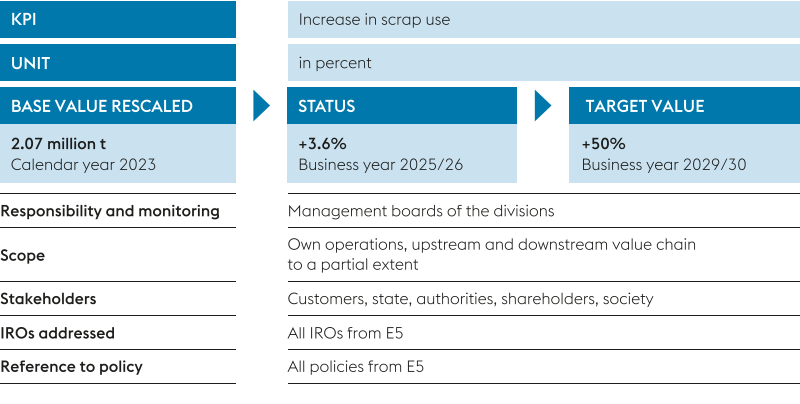
Due to a change in the Group structure (sale of Buderus Edelstahl) and the associated elimination of scrap-based production in the business year 2024/25, the base value for scrap use was adjusted from 2.25 million tons to 2.07 million tons.
The reduction in the use of primary resources associated with the target can reduce the impacts on the loss of biodiversity in the upstream value chain (extraction of raw materials).
E5‑4 – Resource inflows
As a producer of iron and steel products, voestalpine’s main resource inflows are iron carriers such as ore, pellets, scrap, as well as the reducing agents coal, and coke. The following sections describe the main materials used in more detail.
Raw material:
Iron ore
Iron ore is the key raw material for the production of crude steel through the blast furnace route and also plays a role in combined production involving direct reduction processes and an electric arc furnace (EAF) in the form of DRI (direct reduced iron, sponge iron), and HBI.
Coking coal
Coking coal forms the basis for the production of metallurgical coke and is therefore an important reducing agent. A reducing agent is a substance that removes oxygen from an ore and thereby converts the oxide into a metal. As part of the blast furnace route, coke, among other elements, reduces the iron oxide in the iron ore to produce pig iron. In addition, metallurgical coke provides the energy required for the blast furnace process.
Iron and steel scrap
Iron scrap is vital for both the oxygen converter (BOF) and electric arc furnaces (EAF). While the use of scrap in the BOF is limited by the metallurgical process conditions, an EAF can be operated with higher scrap use (up to 100% scrap) depending on the required product quality. Some of the scrap used is internally generated circular scrap from our own production, which is reintroduced to the process. Scrap is also produced during steel processing, for example during stamping processes in the automotive or white goods industry, and is then reintroduced into the materials loop as pre-consumer scrap.
Alloys
Different alloys make it possible to achieve specific steel properties. Important alloying elements include chromium, nickel, manganese, molybdenum, and vanadium, which give steel strength, hardness, corrosion resistance, and heat resistance, among other properties.
Water
Water is an important operating and auxiliary resource in the entire production and manufacturing process at voestalpine. It is used to cool the units, as process water, and to generate steam used for energy. For more information on water, see chapter E3.
|
|
2024/25 |
|
2025/26 |
|
|
|
|
|
Total weight of products and technical and biological materials used (t) |
|
10,370,906 |
|
10,919,625 |
Percentage of biological materials (%) |
|
0 |
|
0 |
|
|
|
|
|
Total weight of secondary reused or recycled components, secondary intermediary products and secondary materials used to manufacture the company’s products and services (t) |
|
1,162,539 |
|
1,079,859 |
Percentage of recycled materials used in manufacturing (%) |
|
11 |
|
10 |
Resource inflows are quantitatively analyzed in relation to steel products and on the basis of a database, which is also used to analyze other environmental metrics and to calculate GHG footprint. The majority of the metrics reported for this database are obtained from direct measurements taken by the companies or verifiable data on quantities provided by the suppliers. In certain cases, quantities are extrapolated from previous years’ figures.
The predefined query structure for data collection helps to prevent double counting.
E5‑5 – Resource outflows
Products and materials
As a steel and technology group, voestalpine offers a wide range of products and system solutions for various industries. These products are produced in four divisions with different focuses:
Division |
|
Business unit |
|
Products |
|
Circular properties |
|
|
|
|
|
|
|
Steel |
|
Strip |
|
High-quality steel strip |
|
Highly durable; up to 100% recyclable; reused through scrap cycles |
|
Heavy Plate |
|
Heavy plates |
|
Durable; repairable; recyclable |
|
|
Foundry |
|
Cast products |
|
High recyclability through recycling in steel production |
|
High Performance Metals |
|
Production/Value Added Services |
|
Tool steels, high-speed steels, copper and aluminum alloys, nickel-based alloys, valve steels, machine steels, special steels, titanium products, services |
|
Reprocessing to extend service life; complete recycling possible |
Metal Engineering |
|
Railway Systems |
|
Rails, switches, signaling |
|
Durable; repairable; reprocessable; long life; interchangeable thanks to modular design; recyclable |
|
Welding |
|
Complete welding solutions |
|
Recyclable base materials |
|
|
Wire Technology |
|
Quality wires |
|
Reusable; recyclable; durable |
|
|
Tubulars |
|
Seamless tubes |
|
Durable; repairable; up to 100% recyclable |
|
Metal Forming |
|
Tubes & Sections |
|
Profile and tube products |
|
Reusable; recyclable; long life |
|
Automotive Components |
|
Ready-to-install system components made of pressed, stamped, and roll-formed parts |
|
Designed for disassembly and recycling; modular design |
|
|
Precision Strip |
|
Precision strip steel |
|
High durability; recyclable |
|
|
Warehouse & Rack Solutions |
|
Warehousing technology |
|
Modular expandability and reusability |
As voestalpine predominantly manufactures intermediate products that are further processed by its customers, a direct assessment of the final quality and associated statements on durability, reusability, and recyclability are only possible to a limited extent. For example, the same material, such as a heavy plate, can be installed in a ship’s hull, a bridge, or a wind turbine, resulting in vastly different service lives. In general, however, steel products are long-lasting, highly repairable, and fully recyclable and can be reintroduced into the steel production process as scrap.
Depending on their application, steel products can have a service life of a few years to several decades. Regardless of the service life, steel products can theoretically be fully recycled time and again. Due to material losses in the closed circuit, it is currently assumed that substitution potential stands at 95%.
Compared to the products themselves, their packaging is of negligible relevance to voestalpine: packaging is assumed to make up less than 1% of the overall product weight.
Waste
Steel production and the further processing of steel products generate various waste and recyclable materials, most of which can be reused in voestalpine’s operations or recycled in other industries. If recycling is not possible for quality reasons or due to legal regulations, waste is treated and disposed of in line with the pertinent legal requirements.
Typical waste streams in the iron and steel sector:
- Slag is primarily a mineral phase composition produced in iron and steel production that can be used or disposed of in other industrial sectors, depending on the legal requirements for the material stream. For particular use cases, slag can also be classified as a by-product
- Dusts may contain metallic and non-metallic particles and are produced during exhaust gas purification, e.g., in dedusting plants.
- Sludge produced by the wet scrubbing of exhaust gases and in the treatment of process and waste water, for example, and consisting of various mineral phases and/or metallic components.
- Scrap and ferrous materials, such as metal residues, scale (oxidized metal particles) and other ferrous waste, which are largely reused.
At Group level, a survey of all metrics relevant to the environment takes place on an annual basis using an online reporting system. Waste-specific data is collected by local experts and definitions of waste types are entered in accordance with national requirements. The majority of the reported waste generation is based on direct volume measurements, which are also required by local regulations and verified by external bodies (e.g., the local authorities). Remaining residual quantities are extrapolated using the previous year’s figures or indicative values.
In tons |
|
Hazardous waste |
|
Non-hazardous waste |
||||
|
|
2024/25 |
|
2025/26 |
|
2024/25 |
|
2025/26 |
|
|
|
|
|
|
|
|
|
Waste diverted from disposal (re-use) |
|
|
|
|
|
|
|
|
Preparing for re-use |
|
5,019 |
|
5,173 |
|
15,237 |
|
20,996 |
Recycling |
|
7,027 |
|
7,242 |
|
106,661 |
|
146,974 |
Other recovery operations |
|
88,341 |
|
91,041 |
|
639,967 |
|
881,841 |
Overall |
|
100,387 |
|
103,456 |
|
761,865 |
|
1,049,811 |
|
|
|
|
|
|
|
|
|
Waste disposed of |
|
|
|
|
|
|
|
|
Incinerated |
|
2,804 |
|
2,101 |
|
4,552 |
|
2,355 |
Landfill |
|
12,153 |
|
9,106 |
|
100,146 |
|
51,816 |
Other form of disposal |
|
78,526 |
|
58,839 |
|
350,511 |
|
181,356 |
Overall |
|
93,483 |
|
70,046 |
|
455,209 |
|
235,527 |
|
|
|
|
|
|
|
|
|
Total amount of waste generated |
|
193,870 |
|
173,502 |
|
1,217,074 |
|
1,285,338 |
Share of non-recycled waste (%) |
|
48 |
|
40 |
|
37 |
|
18 |
|
|
|
|
|
|
|
|
|
Of which radioactive waste |
|
0 |
|
0 |
|
– |
|
– |
Higher potential for the recycling of slag from production processes has reduced the share of non-recycled waste compared with the previous year.
ESRS disclosure requirement |
|
Paragraph |
|
Datapoint/metric |
|
Basis for the preparation and description of the assumptions and methodology |
|
Information on sources of a high level of measurement uncertainty and information on measurement |
|
|
|
|
|
|
|
|
|
E5‑4 – Resource inflows |
|
31c |
|
Weight of reused or recycled secondary components, intermediary products, and materials (including packaging) |
|
The parameters are based on data collected internally and have been converted to the business year for reference factors. |
|
Measurement uncertainty of internal data collection systems and estimate for quarters |
E5‑5 – Resource outflows |
|
37a |
|
Total amount of waste generated |
|
|
||
E5‑4 – Resource inflows |
|
31b-c |
|
Biogenic and recycling content of resource inflows |
|
|
||
E5‑4 – Resource inflows |
|
31a |
|
Material input |
|
|
||
E5‑5 – Resource outflows |
|
36a |
|
Product longevity |
|
|
||
E5‑5 – Resource outflows |
|
36c |
|
Recyclable content |
|
|