Metal Engineering Division
In millions of euros |
Change |
||
|---|---|---|---|
|
04/01– |
04/01– |
|
|
|
|
|
Revenue |
1,087.0 |
1,048.2 |
−3.6 |
EBITDA |
102.0 |
91.0 |
−10.8 |
EBITDA margin |
9.4% |
8.7% |
|
EBIT |
54.4 |
43.7 |
−19.7 |
EBIT margin |
5.0% |
4.2% |
|
Employees (full-time equivalent), end of period |
15,008 |
14,821 |
−1.2 |
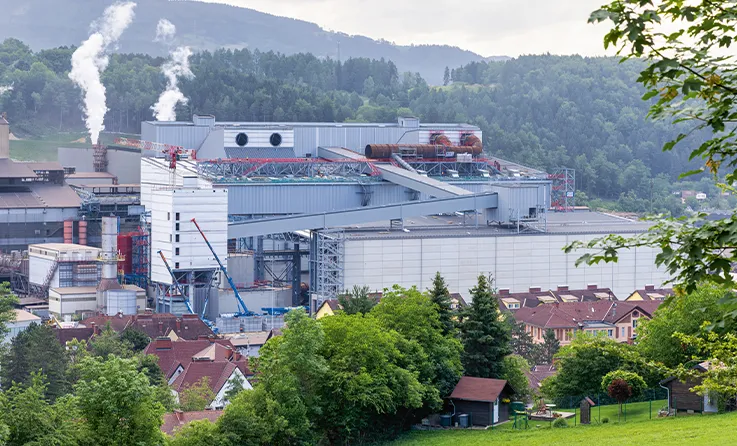
greentec steel in Donawitz
As planned, voestalpine will commission an electric arc furnace (EAF) at its Donawitz location in just under a year.
Business development
The Metal Engineering Division posted an overall stable performance in the first quarter of the 2026/27 business year amid challenging economic conditions. The Railway Systems business unit continued to perform robustly. The Industrial Systems business unit, however, presented a mixed picture: While individual areas remained stable or showed slight improvements, other segments continued to be weighed down by subdued demand, regional competitive pressure, and trade policy conditions.
In the Railway Systems segment, the rail infrastructure business remained robust in the first quarter of 2026/27. In the Baltic States, voestalpine Railway Systems secured its largest framework contract to date, with a volume of approximately EUR 470 million, as part of the strategically significant European infrastructure project “Rail Baltica.” The contract covers the delivery of high-tech turnouts, including digital monitoring systems, and strengthens voestalpine Railway Systems’ position as a leading global provider of system solutions for railway infrastructure.
The Track Systems product segment (formerly the Rails product segment and now operating as Track Systems), which focuses on the European market, continued to perform steadily in the first quarter of the 2026/27 business year. Capacity utilization remained at a good level, with high order volumes in the DACH region and projects in Southeast Europe making a significant contribution.
The globally positioned Turnout Systems product segment recorded growth during the reporting period. Demand in Europe was satisfactory, and the overall trend in North America was also positive. In Asia, additional project activity—particularly in China—supported performance, while the market environment in India remained challenging due to project delays. South America performed slightly better than expected, while performance varied across Africa but was positive overall.
The Signaling product segment (sensor and signaling technology) performed well in the first quarter of 2026/27. Demand was slightly above expectations. Temporarily weaker performance in Europe was partially offset by demand from the U.S. market.
The Fixations product segment (fastening systems) showed an overall positive trend in the first quarter of 2026/27 in the sleeper technology and fastening systems business, attributable to strong demand from Central and Eastern Europe.
The segments of the Industrial Systems business unit continued to show mixed performacne in the first quarter of the 2026/27 business year.
The Welding product segment recorded an overall stable performance during the reporting period. In Europe and across North, Central, and South America, market momentum remained subdued at the start of the 2026/27 business year. In the Middle East, however, demand remained stable, while in China it continued to be positive.
For the Tubulars product segment, the business environment remained challenging in the first quarter of 2026/27. The impact of U.S. tariff policies continued to weigh significantly on sales opportunities. Capacity adjustments were made to mitigate these effects. Against the backdrop of geopolitical tensions in the Middle East, there were temporary project delays and postponements.
The Wire product segment also faced a persistently difficult market environment during the reporting period, though it showed initial signs of a slight improvement. Despite the implementation of the European CBAM (Carbon Border Adjustment Mechanism), prices could only be raised slightly in individual cases due to market conditions. Demand in the core sectors of automotive, construction, and mechanical engineering remained subdued overall. In the area of specialty applications, such as ball bearing steels, tension wires for railroad ties, and specialty wires for wind turbine tower construction, demand remained stable.
As part of the greentec steel transformation program, voestalpine decided in the first quarter of 2026/27 to proceed with the second expansion phase, subject to the required funding commitments. The first phase is proceeding according to plan, with commissioning scheduled for the first half of 2027. Following implementation, approximately 60% of steel production in Donawitz will be converted to greentec steel. The implementation of the second expansion phase will enable the site’s extensive decarbonization by 2030. The decision to bring this step forward was driven by both demand and cost considerations and supports the site’s further development toward a minimill concept.
Development of the key figures
Year-over-year, the Metal Engineering Division saw a 3.6% decline in revenue, from EUR 1,087.0 million in the first quarter of 2025/26 to EUR 1,048.2 million in the first quarter of 2026/27. While the Railway Systems business unit was able to maintain stable revenue levels, the Industrial Systems business unit reported a decline in revenue. This decline in Industrial Systems is primarily attributable to the challenging environment in the Tubulars product segment.
EBITDA in the first quarter of 2026/27 was EUR 91.0 million (margin: 8.7%), down 10.8% from the prior-year figure of EUR 102.0 million (margin: 9.4%). Similar to revenue, the earnings trend was characterized by a solid and stable performance in the Railway Systems business unit. The decline in the Industrial Systems business unit was, in turn, a result of the challenging conditions in the Tubulars product segment. EBIT fell by 19.7% year-over-year, from EUR 54.4 million (margin: 5.0%) to EUR 43.7 million (margin: 4.2%).
As of June 30, 2026, the Metal Engineering Division employed 14,821 employees (FTE, full-time equivalents). Compared with the same date in the previous fiscal year (15,008), this represents a decrease of 1.2%.